Mobidea Sharing Knowledge (12)
Hey STM-ers!
As you know, Mobidea's mission is to help you become financially independent and provide as much value as possible.
We've been sharing our posts from Mobidea Academy for a while now, giving advises on various topics. They are all spread around STM depending on the subject, and it's not that easy to find them all. So that's why I decided to create this thread and help you navigate if you are curious to read more of our articles here on STM.
This thread is where you'll be able to find guides, walk-throughs, tips and tricks! I'll be sharing amazing insights from time to time, and answering questions you may wanna ask!
Feel free to leave a comment, share your opinion and ask questions!
Beginners
Where to buy traffic - https://stmforum.com/forum/showthrea...943#post268943
Beginners most common mistakes Part I - http://stackthatmoney.com/forum/show...l-Half-Avoided
Beginners most common mistakes Part II - https://stmforum.com/forum/showthrea...388#post302388
Skills you need to become a master player - http://stackthatmoney.com/forum/show...074#post299074
Exploring new niches - http://stackthatmoney.com/forum/show...630#post275630
How to choose high-paying CPA offers - https://stmforum.com/forum/showthrea...469#post318469
About Advertisers
Why advertisers are capping your campaigns? - https://stmforum.com/forum/showthrea...515#post307515
The Game between you and the advertiser - Part I - http://stackthatmoney.com/forum/show...896#post291896
The Game between you and the advertiser - Part II - http://stackthatmoney.com/forum/show...024#post293024
8 Facts about advertisers - https://stmforum.com/forum/showthrea...516#post315516
Optimization
CPM or CPC? - http://stackthatmoney.com/forum/show...227#post277227
Tips on how to increase your profit - https://stmforum.com/forum/showthrea...083#post303083
When to stop a campaign? - https://stmforum.com/forum/showthrea...532#post310532
Advantages of using DSP - https://stmforum.com/forum/showthrea...493#post312493
What is a Supply Side Platform? - https://stmforum.com/forum/showthrea...-Side-Platform
Make your website go viral! - https://stmforum.com/forum/showthrea...602#post329602
Tools
Best Spy Tools Around - https://stmforum.com/forum/showthrea...836#post300836
All Mobidea traffic sources reviews! - https://stmforum.com/forum/showthrea...142#post321142
Best tools for an affiliate marketer - https://stmforum.com/forum/showthrea...041#post312041
4 Best Trackers Review - https://stmforum.com/forum/showthrea...300#post313300
Everything about WordPress themes - https://stmforum.com/forum/showthrea...366#post316366
Web Hosting Services you should check! - https://stmforum.com/forum/showthrea...109#post319109
What's an API and how to use it in Affiliate Marketing? - https://stmforum.com/forum/showthrea...267#post323267
What VPN Service to use? - https://stmforum.com/forum/showthrea...690#post324690
Productivity tools for affiliates - https://stmforum.com/forum/showthrea...140#post326140
Industry
Trends of 2017 and further - http://stackthatmoney.com/forum/show...706#post299706
The Best Affiliate Marketing Verticals of 2017 - https://stmforum.com/forum/showthrea...641#post301641
Tips to help you Avoid Scam - https://stmforum.com/forum/showthrea...046#post305046
BlockChain and its influence on Affiliate Marketing - https://stmforum.com/forum/showthrea...349#post312349
Interviews
Manu Adefy at AWE 2017! - https://stmforum.com/forum/showthrea...897#post322897
IAmAttila at AWE 2017! - https://stmforum.com/forum/showthrea...605#post320605
Mr Payne at AWE 2017! - https://stmforum.com/forum/showthrea...670#post318670
Charles NGO Interview on Sweepstakes - https://stmforum.com/forum/showthrea...on-Sweepstakes!
ClickAdu explains it all about PopUnder! - https://stmforum.com/forum/showthrea...731#post311731
Native
5 Fundamental Facts about Native - https://stmforum.com/forum/showthrea...800#post305800
What are Native Ads and when to use them? - https://stmforum.com/forum/showthrea...654#post313654
How to create Native Ads in 2018 - https://stmforum.com/forum/showthrea...887#post328887
Creatives
Everything about Pre-Landing pages - https://stmforum.com/forum/showthrea...400#post308400
How to create banners that convert - https://stmforum.com/forum/showthrea...747#post314747
How to create a landing page? - https://stmforum.com/forum/showthrea...033#post316033
What is a "misleading banner"? - https://stmforum.com/forum/showthrea...505#post317505
Best tools to translate your creatives - https://stmforum.com/forum/showthrea...888#post317888
Facebook
How to write clickable Facebook Ads Headlines - https://stmforum.com/forum/showthrea...008#post311008
Facebook Ads - Tips to Boost your campaign! - https://stmforum.com/forum/showthrea...-your-campaign!
Alternatives to Facebook Ads - https://stmforum.com/forum/showthrea...967#post329967
Adult
Adult Traffic - Give it a Chance! - https://stmforum.com/forum/showthrea...010#post314010
CPA Mobile: Broad Concept
CPA stands for cost-per-acquisition or action. But, what’s an action and what's an acquisition? Does it imply an actual cost? And who pays for it?
This is it, guys! This is that point where everyone’s heads start imploding, teeming with several unanswered questions.
Let's clarify and demystify these concepts in the following paragraphs, deconstructing every piece of this overwhelming puzzle.
[Disclaimer: This post was originally published on Mobidea Academy]
What’s an Action in Affiliate Marketing?
In the Cost per Acquisition (CPA) online advertising price model, an action means the user has to perform a specific task such as a sale or a click. It’s not enough for the user to view an advertisement or to click it, as it occurs with CPM and CPC, correspondingly. The user needs to acquire, to have an intention, to be interested.
It is more difficult to attract users and galvanize them so they get something, but in the end, isn’t that what every company wants? To sale, to increase the client database, to boost those super sweet revenues?
The only difference between CPA and other pricing models such as CPM or CPC are the means to achieve the goal - conversion.
Kinds of Actions
The most common types of actions are definitely subscriptions: the user pays an amount to get a product or a service during a specific period of time. For those actions, the advertiser – the owner of the offer – pays an average amount of revenue per user. This means that the CPA can be the same for a user who remains associated to the subscription service for three weeks or for one who only stays for one quick week. It’s an estimation and an average number, since we can never guess each user’s actual behavior.
However, an action doesn’t only refer to a cost.
CPL – Cost Per Lead – is a similar pricing.
Ever been able to check those viral sweepstakes offers in the form of a contest where the user only needs to fill some data to fire a pixel, and a conversion? That’s referred to as a lead: a user who is a potential client.
Now you’re asking: how can an advertiser make money by paying per lead, and receive no payment whatsoever from the user?
CPL offers are a way for the advertisers to build a database of interested users and to later sell them paid products. Remember… at the end, this is the goal of each company.
But do of course advertisers don't manage to turn all leads into customers. Since the user only needs to insert some data, the conversion rate is really high, when compared with the normal subscription services. However, the payouts are low, because only a small sample of users can be monetized.
Want to learn about another pretty common action? A sale! This is known as CPS – Cost per Sale.
This is when the user actually acquires a product or a service at one go, and not as a recurrent payment. This means the users pay for the product or service they acquire, so the payout the advertiser will assign is higher, but the conversion rate is lower, since the user needs to clearly spend money, usually via credit card.
Therefore, a subscription, a lead or a sale, can all be considered as actions. Sometimes you may get confused in the game, since ACTIONS are quite the broad term used for every occasion. Even so, when we refer to CPA offers in mobile content, the idea of subscription comes to mind!
Comfortable with these terms and concepts? Let’s now look at the players in the puzzle.
CPA Game – The Players
Starting from the beginning, just like a story: the story of an action.
Once upon a time… A user was navigating on their mobile device, checking their favorite content or the latest news. Just as it happens every single day, he access a web page and see an advertisement. He's a potential client for a specific type of product and he's lured into acquiring it.
Who inserted the ad or set of ads in that webpage? The publisher. The owner of the website was able to identify the type of user. Then, they decided to show them the best ads – the ones with a higher probability to convert.
The user has viewed the advertisement and it looked appealing, so he reacted by clicking and being redirected to an offer.
This offer was implemented and designed by the advertiser. It kind of blends with the ad and – most of the times – with the website’s layout.
Note: the advertiser didn't work directly with the publisher, but the affiliate showed the offer hr thought best suited the potential user’s wishes. This means the user entered the offer, saw the content and decided to acquire the product through his mobile phone. He didn’t need to make a bank transfer afterwards or to call a specific number to confirm the purchase. By accepting it on the offer page, the carrier was able to charge the user directly and get him to pay.
The user was pleased with the product and the price he paid, and lived happily ever after – or until the next action.
The CPA mobile ecosystem is impressive… and at the end, who paid for the product? The user.
To whom? To the carrier (operator).
And others? The carrier distributed the price the user pays by giving a commission to the advertiser, who pays a commission to the affiliate network, who then pays a commission to the publisher.
Get it?
The story I’ve so brilliantly told you is a very short story of a user’s action. Now you can try to imagine these players increasing in number. I’m referring to those awfully big agencies or networks, which actually provide complementary services and get part of the commission. The product needs to be really good so the user pays more for it.
User
If I’m a user, I’m the one that actually brings money to the table. I’m the most important piece of this ecosystem since I’ll be tempted to buy the best type of products/services – the ones that best serve my interests. However, not all stories end with a smile.
Sometimes, I can be subjected to ads that aren’t related with the final product, or products that aren’t real, or services that I struggle to unsubscribe from.
There’s one thing I can guarantee you: if the product is really good – even if it’s more expensive – I’ll be willing to pay some more. By paying more, I’m already adding value to the chain.
Publisher
If I’m a publisher, I just want to monetize my traffic. I provide the space, but I want money in return. I wanna pay less for my traffic while receiving the highest revenue possible.
I’m looking for the best-converting offers and the cheapest traffic. I’m focused on finding good affiliate networks that can provide me suggestions on how to monetize traffic in a more profitable way and help me find those saucy gold mines that have almost no competition at all. On top of that – if I can provide the best traffic to those awesome offers – I’ll know users will be interested and super happy with the product!
Affiliate Network
If I’m an affiliate network, I’m focused on making the best combination of traffic and offers, by providing quality traffic and negotiating the best offers with the best payouts in the market. If I have global offers with a high performance, an interesting pool of publishers and advertisers, publishers who send quality traffic and advertisers who pay on time, I won’t have anything to complain about.
Advertiser
If I’m an advertiser, I’m only focused on getting a high volume of users acquiring my products and staying in the service as long as humanly possible. Even so, I have to make good estimations, as I can’t give a higher CPA to the publishers than the real value of the actual user.
Plus: if I create good, innovative and interesting products for my users, I can make them pay more and add value to the ecosystem.
Carrier
If I’m a carrier, I’m looking to monetize my current client database by providing Value Added Services (VAS). Not just any service, but the ones that are interesting for the user, the player that will really pay for it, the one who generates that saucy money. This means I need to make sure I charge the user correctly.
I also need to be certain that I actually comply with the rules and regulations of the market. Otherwise, I’ll be assaulted by fines and complaints when users finally realize the product isn’t what they were expecting.
That's it!
In conclusion, the market offers an array of different ways for you to acquire users, even those who aren’t really interested in that specific product or service. Nevertheless, that’s just unsustainable in the long run. In fact, for a user to be happy, the CPA mobile ecosystem needs to be able to provide good, innovative, cheap and interesting products or services.
Hey guys!
Continuing our previous post, lets talk now about Cost-per-lead (CPL).
You might say: “I know what is Cost per Lead advertising. CPL. Cost per Lead programs. Got it. I know all about it.” And that's that. You are right, no doubt about it!
Even so, there’s more than meets the eye when it comes to Cost per Lead marketing.
[Disclaimer: This post was originally published on Mobidea Academy]
What is a Lead in Advertising?
In advertising, a lead has to do with the contact details of someone interested in a product and who’s therefore a potential consumer of other products from the advertiser. It’s basically an information about a targeted customer – a future money making source. The advertiser isn’t making money on the users they’ve received just yet.
Even so, for you to have a firm grasp on what is Cost per Lead, you need to understand something: behind each lead in advertising, there lies a specific purpose created by the advertiser. That’s why we must get to know a lead’s “family members” for you to really understand the whole deal.
We’re referring to the types of data/information that can be requested from the user. In fact, it can be general user data such as name, country, address, zip code, phone numbers, credit card number (without any charges), signup form submit, or an email submit.
First, the information received gets analyzed and validated. Generally, this process takes about 72 to 96 hours, and is only activated after getting sent to the client – the owner of the service. The advertiser isn’t making money immediately, he's not getting a return on all the leads, or the leads must be validated, etc. It takes a whole lotta time.
That’s why – behind this whole process – there is the motivation that is the basis of all advertising: to effectively turn interested customers into real-life, actual buyers.
What is Cost Per Lead?
Often shortened to CPL, Cost per Lead is basically an online advertising pricing model, in which a particular advertiser pays for a signup from a customer who’s interested in the offer the advertiser is promoting.
This model can also be known as online lead generation or lead generation Cost per Lead. Cost per a Lead or CPL is directly related to CPS services.
What's the difference? In CPS, the advertiser pays per each validated lead that has been generated, meanwhile CPL refers to following:
- Sweepstakes
- Gambling
- Coupons & Vouchers
- Surveys
- Newsletters
- Dating services
The CPL model is quite safe and easy to work with. Since the user only needs to insert some data, the conversion rate can be really high, especially when compared with the normal subscription services. However, the payouts are usually low, because once the data is delivered to the owner of the service – not all customers will turn into buyers.
At Mobidea we talk with advertisers every single day, we know what they want and always manage to build a strong relationship. Our Crew is restless - we do our best to spot all those little mistakes and invalid leads. With that information we help you optimize your traffic like a master!
Now that you know what Cost per Lead is all about, it's time to compare it with another famous and super popular digital advertising model: CPA or Cost per Acquisition!
Cost per Lead (CPL) vs Cost per Acquisition (CPA)
Cost per Lead compensates you when someone views an ad on your site, clicks that ad, and then takes an action to become a qualified lead for a sale.
As you know, CPA stands for Cost Per Acquisition, and it’s a model where leads are only paid for in the event that the user completes an action. This means the user needs to make a purchase or an acquisition of any product.
What’s the difference?
With a CPA model, the conversion happens immediately. The sale is made and the affiliate gets paid. With the CPL model, advertisers pay for a qualified signup from a consumer/user interested in the offer.
In the end, what’s the main difference between the CPL model and the CPA model?
It’s the fact that the signup consists of a “lead”, which can simply be a user’s contact detail, such as a zip code, an email address, or a phone number. This info is later used by advertisers to try to sell their products to the consumer either through newsletters, email campaigns, or phone calls. In the CPL model, the offers usually have a lower payout than the ones which belong to the CPA model, because the publisher is going to be facing a lower risk, since a lead is “easier” to get than a purchase.
This will lead to a lower payout and to the fact that the advertiser risks more by having to actually convert a user into a sale.
How to Monetize Cost per Lead Offers
These two models have a lot in common, so you must always balance these two options to make sure you maximize affiliate marketing profits like a sweet king.
We can take Sweepstake as an example. Those are super popular all over the world and in fact, they’re the most common type of CPL offer. There’s also Health & Beauty offers, offers related to financial companies (Visa, American Express, MasterCard, etc.), Coupons (Amazon, Starbucks, Zara, Costco, etc.)
So there's a lot of different Cost per Lead types of offers for you to explore, but all of them have something in common: in every possible CPL scenario, the user must always complete a kind of questionnaire, leaving some personal info that will later be used by the advertiser.
Now, how to engage visitors?
Tips for Maximum Offer Engagement
Call-to-Action button
Call-to-Actions are super important and one of the online advertising staples. You must always use a fine-tuned CTA or any other kind of strong message. The goal is to make sure users are enticed and wanna click like crazy!
Landing Page
A landing page is a key component of any worthy affiliate marketing arsenal of amazing weapons. A good landing page should be related to the offer. It’s a great tool for you to engage users and galvanize them to take action.
Forms & Questionnaires
Wanna get that engagement high in the clouds? Use forms, questionnaires, or simple games. These are remarkably successful ways to get the attention of your users! Once you put all these tips together, you should use your promotional channels to link and drive your traffic.
Future Opportunities and Trends - summing up AWE interviews!
The world of affiliate marketing is made of a great deal of new opportunities. New verticals to explore, new ways of playing the traffic game, new technological innovations which trigger brand-new platforms and ways of perceiving the whole business.
Affiliate marketing is also made of threats. Those, that hinder the progress of the business. New rules and regulations that can damage revenues for everyone involved.
We spoke to several Masters of Affiliate Marketing game, Leaders and Influencers - people that really know what they are talking about, and here is what they think about the future of Affiliate Marketing!
Check the video below 
 Originally Posted by
How to Create a Six-Figure Blogging Business in 2018
Hey STM-ers!
As you know, )
This time we were lucky to have Zac Johnson writing for us and sharing his professional tips about blogging business. This sounds awesome, but one of his blogs brought him once more than $800.000! And now he is ready to share his insights on how to make this happen.
[Disclaimer: this article was originally published in Mobidea Academy]
How to Create a Six-Figure Blogging Business in 2018
When you started to read the title of this article, you probably had a few different thoughts in your head. You probably think you know how to create a successful blog and that a blog is easy to start, so it must be easy to create a six-figure business with a blog. If that’s the case, you’re only half correct.
A blog is extremely easy to create, and extremely affordable too. Bearing that in mind, there are also more than 300 million blogs on the internet today.
Guess how many are actually making money? Not many.
Bearing all of that in mind, this reference guide is going to walk you through the three major pain points of creating not only a successful and profitable blog but also one that can generate six figures per year in the process.
Before we even get started, the most important thing for you to remember throughout this guide and while creating and maintaining your blog is this: if you want to make money with a blog, you need to treat it like a real business.
No one is going to create a blog, spend $5 a month on hosting and make a million dollars. Blogging is a tough business. It doesn’t only need drive and determination. You can’t just do things half-way and expect results. It’s just not going to happen.
In order to make money blogging, you need to have a real business model, which is what I’m now going to walk you through. Wanna take blogging for business to a whole new level?
Then come with me! I’m gonna teach you how to start a blog business and how to have a successful blog!
Step 1: Know Your Niche, Know Your Audience
The success of your blog or website is pre-planned even before your site goes live.
You really need to create a blog business plan you can trust.
Just like any other business, there’s a lot of work and preparation that must be done before getting started.
While you won’t need to hire staff, get a franchise license, or even hold inventory, you’ll need to come up with a blog and business model that makes sense.
In the world of content creation and blogging, this is known as niche marketing.
The more niche focused your site and content are, the easier it’ll be for you to find success, target your audience, promote your content, and make money in the process.
Even if you think you have a niche topic, think again, it’s probably not niche enough.
In one of my guides you’ll see how I walk through the process of going from a generic topic like “basketball”, to “basketball skills training”, and then “basketball jump training shoes”.
Guess which of the three users navigating search engines knows exactly what they’re looking for when they type those keywords? And guess which one of these keywords is more likely to be written by a user who’ll buy on a website or blog that provides them with the best content or guidance possible?
“Basketball jump training shoes” of course!
Step 2: Content Creation with a Call-to-Action
“How to blog for your business?”
After deciding on a winning niche market, it’s then time for you to think about the content you’re going to create.
This is where a lot of bloggers and site owners go wrong.
Content creation is great, but without a call-to-action and a monetization method, it’s just more content to clutter up the internet. The truth is that your site really only needs to have 5-10 pages of content to be successful. However, it’s extremely important to make sure all of those pages showcase very long content that’s better than the content provided by your competitors.
The pages of your website should also be working as a sales funnel or sales page for whatever it is you’re promoting.
Going back to the example about “basketball jump training shoes”, there’s only so much you can say about the topic, but there are many things people are searching for before actually investing in a pair of athletic training shoes or even a jump training course.
I’m referring to detailed guides that cover such topics as how to jump higher, how to dunk a basketball, best shoes for jump training, or best exercises to jump higher.
These will all target the right audience.
What to do?
You just need to make sure a Call-to-Action is built within your content so visitors aren’t reading your content and then just leaving your site.
If you think the “basketball jump training” idea is a bad example and there’s no way to make six-figures with such a topic, think again!
Some of the best-selling products on ClickBank are for jump training programs and online courses that are generating that much money each and every month.
Step 3: Promotion, Promotion, Promotion!
And now it’s time to focus on the most important part yet: сontent promotion!
As mentioned earlier, there are more than 300 million blogs on the internet today and more than a billion active websites in total. That means there’s a whole world of content out there being created daily, all for your site to compete against.
Most sites are just “creating content” and not putting in the necessary promotion. If you want to find success with blogging, you need to rank in the search results. Moreover, you need to get a lot of targeted traffic to your site.
Here’s a list of some of the best ways to get more traffic to your site and improve your search rankings in the process:
- Creating unique infographics
- Blog commenting on other sites
- Guest blogging
- Social media sharing
- Starting a podcast
- Interviewing other bloggers
- Starting a YouTube video channel
- Going live with your own site mailing list
- Engaging in Facebook Groups related with your site
I can’t stress this enough: Don’t think it’s going to be fast or easy to find success and profits with content creation and building a blog-based business.
It’s also not going to cost you a lot of money in the process, though. I was able to create a website that generated over $800,000 in profit in just a few months’ time (with no paid advertising), even though it’s rare for someone to experience these big wins.
However, the long-term business model that I laid out for you above still works today.
If you follow it correctly, you’ll see the results!
Bonus Step: Paid Traffic and Lead Generation
Now that I left you with a sour taste in your mouth about how you’re gonna fail to make millions overnight and will actually need to put some time, work and effort into this, I’ll give you another big tip: If you want to make money online, you really need to spend money in the process.
This is especially true if you don’t want to sit around and wait for the search engines to index your site, while also waiting for it to grow in authority so it can rank against the competition.
When you have money to play with, you can then start looking at paid traffic, at how to get paid for traffic on a website, and you’ll also need to know how to use lead generation to increase your revenue. This can still work well even with the basketball training concept mentioned above. Simply target the same audience you always had in mind, but go after paid keywords, demographic audiences through Facebook Ads and also media buying on other sites to send traffic to a sales funnel or autoresponder series.
To explode this method and earnings even further, after you’ve found success with sending leads and sales to an affiliate program, you should then start to consider your options with creating a unique product and course of service of your own. This way, you’re getting 100% of the earnings. After all, you’ve already built the platform and have the audience, so why not keep it for yourself and build up what you have?
Conclusion
This is how you take blogging for a business to a whole new arena. Follow these steps and always focus on the end goal of providing value and monetizing the audience coming to your site
Hello there, media buyers!
For years of intensive media buying, we have collected a number of successful stories in many different verticals.
I want to share one of those.
[Disclaimer: This post was originally published on Mobidea Academy.]
The offer is no longer active but I suppose this success story may be super inspiring for those who still have doubts and apprehensions when it comes to the wonderful world of media buying and affiliate marketing.
The algorithm is simple here! Indeed, every media buyer should know it: Look for an offer – Test – Optimize – Scale-up – Profit
What’s the offer I’m gonna be analyzing today?
Vertical: Mobile App
Offer: Uber National IOS
Price model: CPI
Traffic type: Popunder
GEO: US (+others)
Rate: $1.5 – $2.3
Volume: 27M impressions
CR: 1,2%
Ready for this tremendously helpful case study?
Looking for an Offer
How does every successful media buyer go about the task of seeking hot offers? There are two simple answers: You can enter Mobidea and check high-converting offers or you can spy!
The internet is an ocean of opportunities and it’s actually filled with different spy tools. As for me, I like analyzing the ad space using AdPlexity. I usually focus on the amount of traffic driven to the offers. It’s a well-known tool and needs no introduction.
On top of the main dashboard, you can see all the possible offers captured by AdPlexity. Now, understand that you can use a drop-down menu to choose from. Still, it’s only half the battle. AdPlexity is still trying to show you a bunch of offers.
Pick the ones which showcase a higher number of hits.
The internet is teeming with great articles about this ad spy tool. You can even enter AdPlexity’s website. It’s got a whole bunch of incredibly useful tutorials for you to dive into. I’ve also used several other tools. In fact, my team and I are now coming up with our own. That’s a whole other ball game, though!
AdPlexity, brothers! That’s what it’s all about right now! It’s a phenomenally important tool and it’s allowed me to find this Uber offer I wanna explore today.
From the get go, I could see it was something really special.
It was the fastest-growing offer and it showcased a huge volume.
Of course, we were excited to make sure it was on the top of our test-plan list.
We arranged a test super quickly, and ran it while the offer was still smoking hot.
Fortune favors the bold! The faster you react, the more chances you have of actually scoring big.
Testing
We found the offer in three networks with satisfying rates.
It got pretty small conversion cappings but enough to allow us to understand which network was performing better.
Our first test was extensive (we usually run $10-$20 tests.)
The offer was fed with $50K US impressions split into 6 parts – 3 for every CPA network, and 2 traffic sources.
Which traffic sources, you ask?
Adcash and Clickadu.
The problem was that we were so excited that we forgot to set whitelists during the first launch.
The result for Adcash was -60% ROI.
What about Clickadu?
0% ROI.
Optimization
As for optimization, there are two crucially important parts: Traffic sources + zones.
There’s another one that you must also take into account - the creatives. We checked all these parameters for both Adcash and Clickadu. Adcash was showcasing several zones which performed with a decent ROI.
We inserted them on our precious whitelist.
As for Clickadu, there were quite a lot of zones with a positive ROI. To scale up, we repeated a test at Clickadu with a volume of x10. Moreover, we didn’t stop the traffic flow from this point because we were making a whole lotta moolah.
The game was definitely worth the efforts: We were receiving new data and optimizing on the fly.
As a result, our work was effectively split into two stages:
Target optimization
ROI improvement by testing the creatives. These intelligent efforts helped us advance and improve. Usually, most apps convert better without any pre-landing page.
Trust me: The screenshots provided by the App Store and Google Play are good enough.
Adding something in the middle is just gonna drop that sweet CTR!
Wondering what is a fundamental must when it comes to media buying campaigns?
A/B testing the promo pages for hot offers!
Here’s a list of ideas that we’ve added to our plan after a fruitful brainstorm!
List of Brainy Ideas
Discounts
What message can be more effective for this offer? A discount coupon? Uber offered coupons for a discount on the first ride!
That really converted for installs.
We got to 80% ROI and seriously increased the amounts of traffic.
Still, there’s always room for improvement.
Personalization of Promos
We decided to try personalized ads. We received detailed information about top-converting cities, which made it easier. Then, it was time for us to integrate some macros detecting and using the precise city location.
The numbers were different from one city to another.
Even so, there were times when we were getting a ROI of 500%. All we had to do is ask to increase the caps.
Limited Offer
Has the optimization reached its limits? Hell, no!
We used a limited offer, since we needed a massive growth of installs and instant orders and… Jackpot! We received an extra growth of ROI.
A bunch of our A/B tests with promo materials weren’t that impressive. In fact, there’s no massive growth to be reported here. Nevertheless, they were useful because they allowed us to play with a variety of CTA elements such as backgrounds, fonts, colors etc.
Targeting
We knew the cities which had the highest ROI rate. This means we were able to narrow the targeting, focusing on specific cities.
We have successfully used this for more than a month for Uber national to make extra ROI. We were buying traffic from all the decent networks that allowed for city or IP targetings.
Alright!
Time to wrap this up!
Let’s write some important theses to make sure you understand which insights to take from this affiliate marketing lecture!
So what shall you do? Simple:
- Get a good offer
- Be sure of your sources – getting a good ROI without a whitelist is something rare. A good self-serve platform is a must
- Optimize: split traffic flows to cities by using city targeting. The previous test was used to determine the cities that have the best ROI and to set the options
- Create personalized creatives along with the city location
- Use a discount offer
- Use a limited offer
- We tested over 16 landing pages
- 32 A/B tests with promo materials
- CR +172%
Summing up, we witnessed 27.4 M impressions which were driven to the offer with a 1.2% CR.
Conclusion
This conclusion may sound a bit trivial, because the whole process is like a race.
Target the goal, spot the strengths, act quickly, do not hesitate, and never give up.
I know you’ll be able to learn from this and have the chance to celebrate some successful campaigns!
Google AdWords Overview: Everything You Need to Know
Today going through one of the most important traffic sources - Google AdWords!
[Disclaimer: This post was originally published on Mobidea Academy]
What is Google AdWords?
Google AdWords is Google’s online advertising program.
It allows users and companies to advertise and reach audiences that are interested in the products and services they offer on Google’s Search Network as well as their network of partner websites.
As we know, the main goal which stands before today’s advertisers, is to reach the right customers at the right time. In this sense, Google’s advertising program – Google AdWords – helps you to effectively reach users online, it allows you to offer concrete solutions to your potential customers.
Last but not least, Google AdWords also helps you create an additional presence online.
Just like in the world of affiliate marketing, advertisers on Google AdWords pay only per results. Using text-based search ads, graphic display ads, YouTube video ads, or in-app mobile ads, advertisers are able to reach their target audience with Google AdWords by paying (bidding on different criteria) to have their ads placed at the top of the search results page, or get displayed on other websites within Google’s networks.
Google AdWords Account Structure & Setup
Just like every other platform, the Google AdWords account has a specific structure that every advertiser needs to be familiar with in order to run successful campaigns online. The highest level is the account level where the advertisers can adjust the billing information and the time zone.
Each account has campaigns, including inside different ad groups. As for the ad groups, they consist of ads and specific targeting criteria such as keywords, audiences, interests, etc. There’s even a Google AdWords keyword tool, also known as Google AdWords Keyword Planner.
Google AdWords sign in is super simple. The mandatory condition here is that this email address should be a Google account (registered on Gmail). The fact that – once associated with a Google account – you can’t use your email for any other Google account and product.
This means that – if you’re expecting to manage a few AdWords accounts – this is not gonna happen! In that specific case, you must create a different Google AdWords Manager Account.
How does Google AdWords work?
Before we go ahead and dive into the secrets of the platform and create the first online advertising campaign, there’s something we’ve gotta do. We’ll check some important metrics and factors related with Google AdWords.
We’ll also go through the basics of the two main networks: Google Search and Google Display Network.
Google Search Network
If I had to describe Google AdWords in a word, that would be the word “auction”. Let’s imagine that you’re searching for an iPhone on Google.
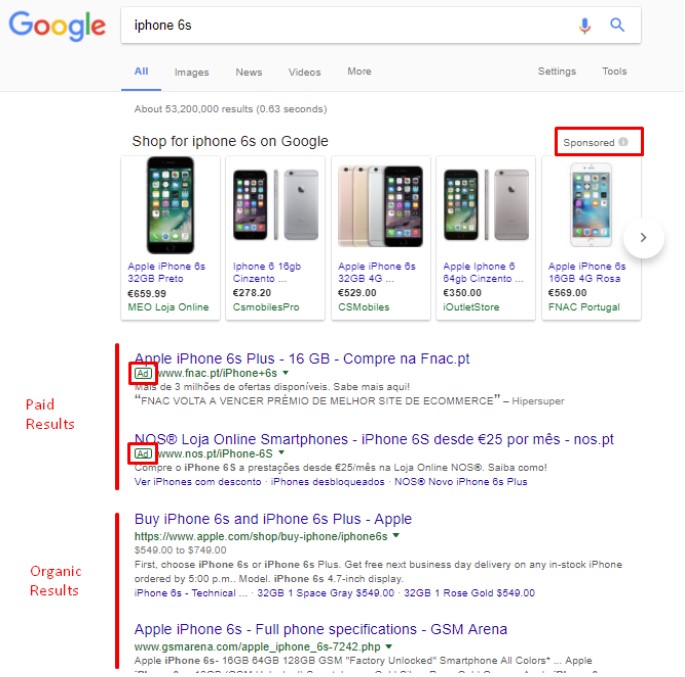
As you can see on the image, when searching on Google, you’ll most often check ads located above and below the organic search results on the first and second page of the search engine. In order for these ads to be shown, the first thing advertisers need to do is to include the same (or similar) keywords within their campaigns on Google Adwords.
If you focus on the example above, we’d be referring to such keywords as ‘iphone’, and keywords which are somehow related to iPhone.
Let’s say you’re looking for an iPhone. You type iPhone on Google’s search bar. Once you hit the search button, Google starts going through all the advertisers who’ve included the keyword ‘iphone’ (or similar keywords) within their campaigns on AdWords, and gets to perform an auction.
If more than one advertiser is bidding on an iPhone for a certain location, and Google decides that the keyword is relevant to the user’s search query, an auction is triggered.
All good.
But now you’re asking: “What are these iPhone photos that I can see above the ads?”
They’re ads, and they’re called Shopping ads and they’re also run by AdWords. However, the principle behind these ads is different.
All you need to know for now is that Shopping ads can also appear on a quick Google search.

Getting back to auction and the keywords: In order for the ads to be shown on Google, the search engine is gonna take some metrics into account.
Which Metrics does Google Take Into Consideration?
Cost per Click (CPC)
When advertisers are inserting keywords within their campaigns, they need to decide how much they’re willing to spend when users click their ads. Taking into consideration the competition and the maximum amount the advertisers are willing to spend (that’s the max CPC they’re choosing, which tends to be less than the actual CPC they’re paying), Google will insert the ad on the SERPs.
Since I’m referring to location, it’s time to move on to the next metric Google cares for.
[B]Ad Rank[/B]
The Ad Rank is responsible for the position your ads are gonna take on Google’s search results page.
It’s based on two things:
- your maximum bid for that specific keyword (the maximum CPC the advertiser is choosing for their keywords)
- another pretty important metric called Quality Score
Quality Score
This is what AdWords is all about. It stands for how relevant your landing page and ads are to the keywords you’ve chosen.
The score is calculated on a scale of 1-10 where 10/10 will basically mean that you’ve got the best-performing keywords.
How to Determine the Quality Score?
Expected Click-Through Rate (CTR)
Before I define what the Expected Click-Through Rate is, let’s first look at CTR itself.
CTR is a metric which measures how often users who see your ads end up clicking and how well your keywords and ads are actually performing.
The formula for calculating CTR is simple: The total number of clicks divided by the total number of impressions times 100.
Let’s imagine that your ad has got 20 clicks and that it has been shown 5000 times.
The CTR of this particular ad would be something like this:
20/5000 = 0,4% CTR
The Expected Click-Through Rate is closely related to the CTR itself.
It measures Google’s estimation of how likely it is that the ad’s viewers will click the ads when shown for a specific keyword.
When calculating the Expected CTR, Google takes the historical data of the keywords (how well they’ve performed) into account, based on the position of your ads.
The possible ratings of Expected Click-Through Rate the advertisers can get are “above average”, “average”, or “below average”, using only the exact match keyword.

The Expected CTR helps you understand how likely it is for users to click your ads when they’re shown for a specific keyword.
A ‘below average’ status means that your ad isn’t garnering any tangible interest to get the users to your website and to complete the advertiser’s desired action.
In addition, a low CTR negatively impacts the Quality Score, and also impacts the costs of your campaigns, which will obviously be higher.
Ad Relevance
This metric connects the keywords to your ads.
It shows you how relevant the keywords you’ve selected are to your ads. Just like with Expected CTR, Ad relevance has three statuses measuring this relevance:
“Below average”, “average” or “above average”.
Landing Page Experience
Remember the iPhone example? Let’s get back to it right quick!
Let’s pretend there’s a user out there in the internet stratosphere. This guy is looking for an iPhone 6s. He clicks your ad and lands on your page, which offers him different types of iPhones.
This is what the landing page experience is all about: Setting up relevant destination URLs for your ads and then driving users to the content they’re looking for.
The landing page experience affects your Ad Rank, CPC, and the position in the ad auction directly. In addition, a poor user experience can reduce the number of times your ads are shown.
Google Display Network
Google Display Network (GDN) is the second main segment of Google’s network.
According to external sources, GDN reaches 90% of all internet users and has got more than 2 million websites within.
Part of Google Display Network are websites such as Google Finance, Gmail, Blogger, YouTube as well as other websites and mobile apps which are partners of Google (Google AdSense websites, DoubleClick Ad Exchange, etc.)
In the image below, you can see an example of an ad located on a website which is a part of Google Display Network.

As I’ve mentioned already, Google Display Network allows you to run text ads along with other types of formats such as image (banner ads), video (YouTube), or rich media (HTML, Flash) ads.
How does Google Display Network Work?
Unlike Google Search network, Google Display Network acts more like a brand awareness of your product or service. It grabs the customer at an earlier stage of the buying process.
Imagine you want to buy a new car. Most people start checking the price, the model, and the best time to buy a car on the internet.
What to do, then?
Grasp this exciting activity.
How?
Insert words and phrases which are relevant to your products and services (contextual targeting) on AdWords.
Afterwards, the platform starts scanning the content of the websites, part of GDN, which are relevant to your keywords. It then shows text ads to your potential customers.
Another type of targeting available on Google Display Network?
You can target by demographics, interests and topics, a different type of audiences. You can even show ads on specific websites of your choice (managed placements).
Undoubtedly, there’s a super powerful targeting feature available on Google AdWords Search and Display networks, but also in lots of other platforms such as AdRoll, Retargeter, or Facebook - Retargeting (Google AdWords remarketing).
It really is one of those Google AdWords fundamentals!
This option is suitable for those users who’ve left the advertiser’s website without completing the desired action:
A purchase, a sign up for a newsletter, or another.
The information for this audience is inserted into specific remarketing lists that the advertiser can set up in the AdWords system, based on the user’s cookie ID.
The Google Adwords system takes this information into account.
It then starts showing ‘reminder’ ads to these users on GDN websites they happen to be browsing.
Can I Use Google AdWords to Run Affiliate Marketing Campaigns?
The answer is yes. Hell, yes!
Beware, though. You should understand that AdWords is very restrictive when it comes to affiliate marketing and some of its shady practices. This means you definitely need to get to know their policies before running any ads.
Moreover, you also have to provide a high-quality website or landing page in which you can highlight the benefits of the specific product or service you’re advertising.
Also, you need to SEND ALL THE TRAFFIC FROM THE AD TO THAT PAGE. I decided to use caps here since most affiliates are using redirects to other web pages.
This is completely forbidden on Google AdWords.
Let’s put it like this, so that there are no illusions: Shady practices are forbidden on AdWords. If you’d like to succeed on this platform, you should be ready to provide high-quality content. It must be relevant to what users are looking for.
What else should you know?
That you must check the terms of each affiliate program to ensure they’re okay with the methods of promotion you wanna go for. Also, you should expect to pay an expensive price for this Google AdWords fest.
When it comes to advertising, Google AdWords is one of the most high-converting traffic sources. However, Google AdWords cost is no joke. In fact, it can be quite expensive - Google AdWords pricing is high.
If you are considering running AdWords campaigns, besides talking with Google AdWords support team about your Google AdWords account, check the Help Section.
Everything is pretty organized. It’s almost like a Google AdWords for dummies.
You can easily learn the basics (even though AdWords isn’t really recommended for newbies).
Wanna know more about Google AdWords? Soon, we’ll be releasing an article that’ll teach you how to effectively launch a campaign on AdWords.
Stay tuned!
Tracking Social Traffic and ROI for Affiliates
[Disclaimer: This post was originally published on Mobidea Academy]
As an affiliate, you may think that global brands have a decent understanding of their social media marketing strategy and its return on investment (ROI.) You think they all probably know how to measure ROI of social media, understanding the complexity of measuring social media impact.
However, a Gallup survey has shown that only 7% of Chief Marketing Officers said they understood the value of their efforts with social media marketing. This means a lot of people out there have no idea of their social media results, and probably fail to evaluate social marketing metrics such as Facebook ROI.
Determining ROI: Why is it so Difficult to Measure?
Return on investment – abbreviated ROI – is a profitability ratio.
In the case of marketing campaigns,in order to measure ROI on social media we divide the net profit by the total cost of a campaign. ROI is expressed as a percentage. This means you have to multiply that result by 100 to get your ROI.
The calculation sounds easy enough. However, in the arena of online marketing, figuring out social media marketing ROI is not gonna be that straightforward. Even though we may know how to craft an effective post, tracking a social customer from the first engagement all the way to a sale is challenging.
Tagging and tracking affiliate links can help improve the landscape, but it doesn’t solve all the issues. With the exception of Instagram and Snapchat, social posts have individual links and can be tagged. However, data still becomes disconnected along the path to the sale.
Links lose their parameters, users view a website on a smartphone but make the purchase on a laptop hours later when they arrive home, mobile apps don’t necessarily pass the referrer to the website, a non-secure URL fails to pass on information to an HTTPS page, etc.
In a past survey of marketing professionals, it was revealed that 88 percent said they were not confident they could accurately measure their ROI. What makes it so difficult to measure ROI? It’s certainly not a lack of data.
We have many metrics for social media and follower engagement: follower count, likes, shares, hearts, comments and re-tweets all help to show us which content is popular. We want to understand such things as the best time of day to post, the ideal social channels that connect with our target audience, and what content resonates best with followers.
Can We Truly Measure the ROI of Social Media?
Yes, we can indeed measure the ROI of social media, but it’s complicated. In fact, the ability to quantify social media return on investment is a fine art. Even so, it’s one of the key metrics for social media advertising success.
There are different types of social media posts: paid, organic, and earned. You can only tag and track online properties that you control. This means the type of post influences the measurement method.
Paid social media posts are those we are spending money on to get more engagement, views, or website traffic. They have an ad budget, even though it can be small.
Organic posts, also known as earned or free posts, have no advertising dollars behind them. They gain engagement based on their content only.
Finally, earned posts are those that others post about your products or brand. Sometimes, these are user-generated content. However, they could also be images taken from a brand’s website and reposted by customers or fans on social media channels.
The type of post matters because we want to tag and track the posts, which really is how to measure social media success. Tagging means adding some variables to the posts’ links or using a third-party tracking tagging tool to obtain more information about the customer journey.
For example, we can tag a URL to distinguish clicks that came from Twitter as opposed to Facebook or YouTube, or paid posts versus organic posts. For obvious reasons, we can only tag the posts we own – the paid and owned versions.
How do we measure the shared content? This is where it becomes more complicated.
Social media posts created and shared by others also factor into the value of social media marketing. For earned posts, we should go with correlation. What that means is we are going to look for an increase in website traffic over a period and compare it to post engagement to see the effect it had on website visits.
Taking other data we know about our social customers, such as average time to buy and average transaction value, we will be able to estimate the ROI in social media of an earned post.
Social Media Campaigns: What’s the Goal?
Any marketing campaign, including a social media campaign, should have a defined goal.
I’ve watched many campaigns fail because the expectations were not set at the beginning. There may be more than one goal. Defining what counts as a social media conversion helps define what we are going to measure to understand our ROI in social media marketing.
Typically, most of us want sales that directly translate into a trackable sale with a defined amount. Indeed, most people see sales as the social media campaign metrics that matter the most.
In fact, affiliate marketers are likely to define a goal as a sale. However, there are more considerations to any marketing campaign. For example, what is the lifetime value of a new social media follower? Even though they have not purchased (yet) we can track them and learn about other metrics such as their decision process and length of their consideration phase. What percentage of social media followers convert to become email newsletter subscribers?
After that, what percentage of them open the emails? And how much do they actually spend? Do these numbers differ depending on what social channel the follower is on?
Check some factors and metrics to measure social media success when evaluating a social media strategy:
- Post reach
- Increase in web traffic
- Leads
- Engagement – shares and likes
- New followers
- Newsletter signups
- Downloads
- Video views
- Purchases
Moreover, there are soft goals – apart from ROI goals – that affiliates should consider.
Social media marketing can help discover customer insights such as new products they’d like to see or website usability, or to find new customers and boost customer engagement. It can also increase your brand’s awareness and name recognition.
To know what to look for you shall become an expert in social media metrics!
For example, one of my websites has a few goals.
The first is to get newsletter signups. Other goals include bringing new users to the cyber security job board affiliate program, selling low-cost field guides, and increasing the number of YouTube subscribers.
For the field guides, we can figure out the measurable ROI based on total sales divided by advertising dollars, the cost of creating media for organic promotions, and then the costs of our other promotions. The careers affiliate program is tougher to work with because the advertiser is also running an email remarketing campaign. Although I don’t pay for those emails, they certainly influence the effectiveness of my efforts and reduce costs.
The YouTube channel has AdSense ads so (eventual) profits factor into the profits. Our newsletter signups have no dollar value until they decide to buy a field guide or interact with the affiliate program.
The Value of Increased Website Traffic
Clicks from social media channels drive traffic to your website. That’s got tremendous value, even if the customer hasn’t yet made a purchase.
Publishers can use social media to generate two-way conversations with customers. Many shoppers turn to social media for customer service. They don’t want to place a phone call in fear of being trapped in a phone tree or call center.
Many websites don’t have a support number and if they do, many times it is not live 24/7.
Social media is a convenient customer service tool. I frequently turn to Twitter (no, it’s not dead yet!) when I have a support question.
Depending on the analytics tool you are using and other components of your marketing campaign, you’ll have to make a business decision for your affiliate marketing.
Which click is credited with the sale? Old school eCommerce typically credits the sale to the last click. Meaning, if a customer visits the website from an organic search, signs up for the newsletter, and then later buys based on a click from the newsletter. Then that last click is credited with making the sale.
It would be said that the newsletter was more effective than the organic click. A savvy marketer knows that both are important and the shopper needs multiple clicks to buy.
How do I know they are the same user as someone who visited earlier today?
If it’s a paid social campaign, the users are logged into a social media account!
How Can We Be More Productive as Affiliates?
Remember your website’s role in all of this and use individual pages for offers. Your website’s homepage is going to be the most landed on or the most linked-to page, so add custom landing pages for offers.
This increases the likelihood of making a sale. The fewer clicks to make the purchase or to send the user to the advertisers’ purchase page, the more likely the user is to purchase.
Custom landing pages also give you the opportunity to add customer content supporting the product or service. Try adding a video to increase conversions. Add social media pixels for tracking, along with third-party analytics tools.
This will track users as they enter your website, their path through, and where they leave. This process is crucial for you to see the ROI of social media increase to the max.
Be mindful of page loading speed when adding these trackers. A slow loading website is a big negative for search engine optimization.
It’s helpful to work on something you enjoy or are knowledgeable about. Turning a hobby into a full-time job that pays well as an affiliate is possible! It takes dedication and perseverance.
Tagging and tracking social media posts and all your other marketing channels will help you understand what’s working and what’s not. That way, you’ll be able to focus your efforts on the offers that work best for your audience!
This really is how you can start measuring return on investment to improve your global performance and get those social media marketing results you’re yearning for!
Hope you enjoyed this post, feel free to check the Academy for more info!
Hey STM-ers!
The rise in the price of Bitcoin grabbed most of the headlines in 2017, mostly because it is the first and best-known cryptocurrency.
Starting out at just over $1,000 in January, 2017, Bitcoin’s price surged to over $17,000 in December.
However, other cryptocurrencies have also shown significant gains during the same period. These kinds of returns have attracted the attention of many investors and venture capitalists seeking a piece of the action.
That's why today we are gonna talk about ICO and the increasing number of startups in the cryptocurrency space that intend to raise capital through it.
[Disclaimer: This post was originally published on Mobidea Academy]
What are ICOs and how can they be Compared to IPOs?
An ICO is the cryptocurrency equivalent of a traditional Initial Public Offering (IPO). With IPOs, investors exchange money for equity in a public company.
Cryptocurrency startups use ICOs to raise funds for their new ventures, selling their own cryptocurrency in exchange for legal tender or other cryptocurrencies, such as Bitcoin or Ether.
Whereas IPOs are tightly regulated by banks and the Securities and Exchange Commission (SEC), ICOs are currently unregulated, with no oversight by the SEC.
An ICO is like crowdfunding, except backers expect a return on their investment rather than donating money for a startup. ICOs exchange virtual coins or tokens instead of shares to raise capital, meanwhile IPOs are normally only accessible to high net worth investors, while anyone can invest in an ICO.
How do ICOs Work?
Startups launch an ICO by publishing a white paper or website giving a detailed description of the project and key team members, the budget for the venture, the types of currency accepted for investment, and the timeline for the ICO campaign.
Early ICO investors are often given bonuses.
Most ICOs set a limit on the number of tokens or coins on offer prior to the campaign launch.
Early investors may be given preferential terms, which often include a lower price per coin or token.
While some ICOs may keep the price steady throughout the campaign, others adjust the price according to demand in order to raise as much capital as possible.
There have been valid concerns about the risks associated with ICO investment.
In order to mitigate the risk, ICOs may facilitate their offerings through an exchange or escrow service.
An escrow provides investors with some degree of security against scammers and a means of verifying how funds are spent after an ICO campaign has run its course.
Advantages of ICOs
ICOs offer a number of advantages for both entrepreneurs and investors:
- They provide a platform for startups to raise money faster than conventional fundraising mechanisms. Unlike IPOs or regulated crowdfunding campaigns, ICOs don’t have to go through red tape and documentation to get started. All that is needed to launch an ICO and attract investors is a white paper or a website outlining the venture. This makes fundraising much cheaper
- Investors are given early access to a potentially profitable venture. Some ICO projects can turn out to be highly profitable for early investors. The Ethereum ICO launch in 2014 is a case in point. Its offering of Ether cryptocurrency turned out to be the most successful ICO venture to date. Ether was offered at 35 to 40 cents at launch and is now priced at over $1,100
- Heightened exposure for projects. The creation of a website to support an ICO gives startups the opportunity to showcase influential team members and early investors in the project. This helps to build credibility and trust, and attract further investment
- They facilitate community building. ICOs give entrepreneurs the opportunity to build a strong community around their projects. They also give the community a valuable say in the direction of future projects, enabling investors to keep creators and team members accountable. A strong community also improves credibility and attracts more investors
- Potential for high reward. Although high risk, ICO investments can offer high rewards. To a large extent, investments are not affected by changes in the stock market and the economy
Risks Associated with ICO Investments
Investors need to be aware of the potential risks and disadvantages of investing in ICOs:
- They attract scammers. The unregulated nature of the cryptocurrency industry is something which attracts scammers. The creation of a white paper or website to launch an ICO is no guarantee that it is genuine. These can be full of untruths and inaccuracies which scammers may use to entice investors
- ICOs are speculative by nature. When investing in an ICO project, investors are backing an idea or concept, with no guarantee of success. Statistics show that over 90 percent of startup enterprises in all industries fail, and cryptocurrency projects are no exception
- Prone to investment by whales. Whales are people who have a lot of money to invest in an ICO. They invest early to buy up a large portion of tokens and then sell them later at a premium to get a short-term profit. They basically rig the game in their favor, leaving smaller investors to purchase coins or tokens at elevated prices
- ICOs may not facilitate secure storage of tokens or coins. This will make wallets prone to hacking and fraud, or lead to tokens being lost
- New cryptocurrencies may not be accepted by exchanges. Tokens or new digital currencies lose their liquidity if they are not accepted by cryptocurrency exchanges
How to Avoid an ICO Scam
Investors should look out for signs that an ICO may be a scam and take evasive action.
Check the signs that tell you an ICO may be a scam:
- Weak ICO promotion. If a white paper or website promoting an ICO does not have detail on the project or information about the creators and team members behind the venture, it could be a scam. Investors should conduct a thorough research on all aspects of the project, as well as the company and team involved before committing to the investment
- Unclear roadmap. An ICO launched without adequate detail on development and funding goals may be a scam. It could be an indication that the creators are just looking to make a quick profit
- No cap on fundraising. Legitimate ICOs usually publish their fundraising goals before launching. An ICO without a funding cap may indicate that creators are only in it for short-term profit
- Biased mining structure. A mining structure rewarding pre-launch investors with a significant number of pre-mined tokens may be evidence that the venture is driven by the prospect of short-term gain
ICO Affiliate Marketing
For ICO startups, affiliate marketing presents a way to generate capital faster and without the regulatory funding restrictions imposed by banks and venture capitalists.
Affiliates reach new customer bases and bring in more web traffic for exposure to the project.
ICOs may present an exciting opportunity for affiliate marketers to make money.
However, ICO scams have the capability of destroying a network and causing significant damage to an affiliate marketer’s credibility.
Affiliate marketers have an added responsibility to safeguard the investment of every member of their affiliate network.
This demands meticulous screening of ICOs to determine legitimacy.
It may be easy to be caught up in the emotion and hype surrounding cryptocurrency investment.
Make no mistake: There are opportunities in ICO investments to make a lot of money. However, investors and affiliate marketers need to conduct due diligence on ICOs to assess their legitimacy and potential for profit before committing to any project.
Hey everyone,
Today's topic will be about
What are expired domains and why would anyone need it?
[Disclaimer: This post was originally published on Mobidea Academy]
As you might already know, domain names aren’t issued without a deadline . You pay an annual fee to maintain the ownership of any domain and if you fail to make the payment in the specified time, you lose your ownership rights.
The domain goes up for sale once again and anyone can purchase it. That’s why in order to get your hands on a recently expired domain name, you can buy it through a domain auction or carry out your own expired domain search.
Why Are Expired Domains For Sale and What Can They Be Used For?
You can harness the power of expired domains as a leverage for your new website. Maybe you are building an e-commerce store or maybe it’s a personal blog – whatever the case may be, you want your website to rank higher. An high authority expired domain can help you achieve that.
Build a High Authority Website Right Away
You can start to rank high in Google’s results right away simply by hosting the website on the best expired domains and adding optimized and relevant content. No need for time-consuming SEO and Social Media Marketing (SMM).
One of the ways to check how valuable the website would be for you, is checking which keywords does it actually rank for (if any).
Simply go to SEMrush, input the domain into the URL/Keyword bar and hit “Search” – if the expired domain ranks for anything, SEMRush will show.
Build an Authority Blog for Link Juice
Apart from buying expired domains to build a powerful website, you can also use it to host a blog that contains backlinks to your other website(s).
What’s the point here?
As discussed previously, if the website where backlinks are present has higher authority, it will positively affect the authority of your website.
This is called link juice. You add content pieces on your blog and integrate links that take visitors to your other website. The idea is to use the authority of the expired domain to passively enhance the authority of the other site.
However, this is a black hat practice according to Google’s guidelines, so you need to ensure that Google can’t figure out that the same person is behind both websites (the original and the blog hosted on the expired domain).
Redirect to Your Website or Affiliate Website
Redirection means to automatically take the user to your other website if they click on the link. Your visitors wouldn’t mind being redirected as long as the landing page contains relevant content and information that they are hoping to see.
You can use redirection to take visitors to a page or website that has relevant useful content or where you’re selling relevant products.
For example, if your high authority expired domain is about second hand books that ranks highly in Google and you also sell second hand books on your website, you can redirect visitors to your own website without fear of penalty.
Selling Affiliate Products
You can also buy expired domains to promote your affiliate offers. Affiliate partners are those who give you a percentage on every sale. This is a clever way of making a quick buck.
One of the ways to make the most of this strategy is to sign up for Mobidea. Whatever expired domain you may have, there are high odds that Mobidea would have an offer that’s relevant to your domain’s niche. You simply host your website on the expired domain, place Mobidea’s offers on your website and whenever you make a sale through your website, you receive an affiliate commission!
How to Find High Authority Expired Domains?
Domain Hunter Gatherer
One of the best tools to scrape out powerful authority domains is Domain Hunter Gatherer (20% lifetime discount). It enables you to find powerful niche domain names quickly and with ease.
If you aren’t sure what you are looking for you can simply enter the niche or any related keyword so that Domain Hunter Gatherer can serve you with a complete expired domains list.
Benefits of Domain Hunter Gatherer
- User-friendly installation and setup
- Video guides available for people who need assistance
- Search from a database of more than 14 million expired domain names
- Every expired domain suggested by the software is available for registration
- Every domain comes with Majestic and Moz statistics for better insight
- 16 filters allow you to carry out targeted search
- Expired domains list is served in a txt or csv format file
- Recovering Website and its Contents
When you use expired domain finder to scrape out high authority expired domains for sale, you may want to recover the old website and its contents.
Alternatives to Domain Hunter Gatherer
Other than Domain Hunter Gatherer, you can also use Name Cheap or ExpiredDomains.net.
There is also another opportunity. What if you really like a domain that’s currently in use, but the website behind it doesn’t benefit much from being there, while you, in fact, could.
Always remember that not everyone puts domains on auto-renewal, and that sometimes there are auto-renewal payment issues.
If any of those is the case with your underutilized domain of interest, you can try to “catch” it in the short window of opportunity between the moment it expires and the moment it auto-renews. Simply set an alert for the domain you like, and who knows, you might be lucky!
6 Important Metrics When Buying Top Expired Domains
1. Domain Authority
But why go through the extra effort of finding expired domains when you can easily buy a brand new one at a cheap price? Simply because old domains that have already been purchased and have hosted a website, gain authority which a brand new one can’t offer.
To help you get an idea what is “authority”, pay attention to the Domain Authority (DA) metric from Moz.
The higher the Domain Authority (DA) – the better.
2. Page Authority
Page authority is another metric crucial to your rankings. Basically, whereas domain authority is the calculated likelihood of a particular domain to rank in SERPs, Page authority is the same metric, but on a smaller, page-level scale.
Very roughly speaking , domain authority is a weighted average of the page authority.
Those metrics can be pretty different – usually, a strong domain authority is achieved by a synergic score of pages with notable authority:
There are at least 2 ways to check a website’s Page and Domain Authority:
a) Use the Moz’s Link Explorer
b) Use the Moz Chrome extension – Moz Rank. It will highlight the authority metric in the toolbar or right on the SERP.
3. Moz Spam
Keep a close eye on this one. Who knows why the domain may be expired? What if it got penalized or banned by Google and renewing it just won’t make sense?
That’s the information, that Moz Spam Score gives you.
4. Majestic Trust Flow (TF)
This is a metric from Majestic SEO, a well known tool in the industry. That metric analyses how trustworthy a site is by measuring its quality and measuring the quality (“trust”) from a linking site. That’s how the trust “flow” is created.
The more relevant trustworthy sites are linking to you, the better rank the domain has.
5. Majestic Citation Flow (CF)
It’s basically the same as Trust Flow, just without the “Trust” part. Plainly, it ranks the domain based on how many sites are linked to it, without considering the quality (“trust”) of those websites. This way the increasing number of backlinks would increase the Citation Flow, but not necessarily increase the Trust Flow.
6. Social Media Authority
However, websites authority isn’t limited to just backlinks and quality content. The other type of authority that may have an effect on your rankings is Social Media Authority.
What is it and how is it calculated?
Well, you probably won’t be surprised that social networks are open to search engine protocols just as any other source of content. Naturally, the content and links there aren’t ranked as high as regular website content, but they still get their share of the SERP pie.
Conclusion
With some patience and a little bit of smarts, you can find out many high authority expired domains that you can use for multitude of applications to make money and further your personal goals.
Why do all the work from scratch when there’s an expired domain out there featuring all the positives you need?
One of the few networks really pushing knowledge on a regular base. Added value. Great stuff guys!
Home > Paid Traffic Sources > Mobile