Using optimizers for push traffic (27)
Hello,
I recently joined stm. After reading through the push subforum I sometimes reading about optimizers.
As push traffic is quite competitive I read that you basically have to use it to find a profitable offer as your campaign profitability can stop during the day. (because of the competition)
As a programmer that is turning marketeer I have some questions about it:
- Why should someone use an optimizer? What is an optimizer specifiaclly? How does it give you an competitive advantage?
- What are popular optimizing solutions? Any examples to github or code samples?
- Are there any services that provide optimizers for us?
- I haven´t found many posts about optimizers. Any other threads that you can recommend on stm?
As a newbie I would really like to get a deep understanding and therefore really appreciate your replies!
In the new version of the 40-day tutorial, there will be a lesson on using TheOptimizer to automate campaign optimization.
https://theoptimizer.io/?utm_source=stmforum
In the meantime, please check out their website for more info.
I also used it in my Outbrain tutorial here:
https://stmforum.com/forum/showthrea...e-Noobs-Part-3
Basically you connect your traffic sources to TheOptimizer, and it will change your campaign settings on your behalf according to the rules you set.
To give you some ideas on what rules are available:


The main advantages are:
-Time savings - you no longer need to watch your campaigns like a hawk
-The ability to run a LOT more campaigns at the same time (due to the time savings)
-The ability to keep campaigns with low profits running (those pesky $2/5 per day profit campaigns that normally wouldn't be worth your time to monitor every day if you were running campaigns manually)
-Cost savings - you can pause things at the EXACT point you specify (e.g. placements that have reached 2x payout in loss) instead of "over-running" - and this would be impossible to do manually because you can't possibly check stats every minute of every day
But of course, the service costs money as well. So it would only make sense if you're doing higher numbers than the typically newbie on their first month. STM gets a special discount at the link I provided above.
Also: Check out these posts from @platinum (representing TheOptimizer and LanderLab):
https://stmforum.com/forum/showthrea...r-Job-Than-You
https://stmforum.com/forum/showthrea...ith-Automation
Was this the information you were looking for? If not please let me know!
Amy
And I wouldn´t stop a successful campaign just because its performance drops during a day.
It´s better to watch it longterm and don´t judge it by one days performance.
What are popular optimizing solutions? Any examples to github or code samples?
Are there any services that provide optimizers for us?
I haven´t found many posts about optimizers. Any other threads that you can recommend on stm?
It helps you to keep campaigns running without much manual maintenance.
When you would have to take care of dozens of low profit campaigns yourself it´s mostly not worth it because the time/profit ratio wouldn´t be worth it.

If you use an automated optimization service or software it helps you to still run many of such small campaigns without spending much time on it.
As Amy already said, a good service is TheOptimizer.
I am using it myself as well and it definitely helps when you want to have hundreds of campaigns running simultaneously as a solo affiliate

For example I don´t stop campaigns when the traffic slows down or when they just don´t convert as good as before.
I just set rules on Optimizer like
IF ROI IS Lower Than 10% IN Last 7 days THEN Stop Campaign
That way I can keep even the lowest volume campaigns just running and at the same time I have somewhat of a stop loss to prevent running on losses.
I wouldn´t keep such campaigns running manually because it would be too much work but when you have dozens or even hundreds of such small "expiring" they can still generate some nice overall volume and profit.
@platinum: does the optimizer can stop the zone based on the @vortex placement kill/whitelist excel sheet (which is based on statistics, not if/then rule). If not do you have any plan to implement that.
Do you have any discount form stm member right now ?
Thanks
 Originally Posted by dseopro1000

As I've emphasized on various recent posts and replies, the best way to create reliable auto-optimization rules is to make some calculations beforehand, otherwise it can end up being a mess.
Regarding the discount, yes we do have a discount for STM Members! You can find it here - https://stmforum.com/forum/showthread.php?45267
Originally Posted by dseopro1000
The kill/whitelist formula is overkill for pop placements anyway - when I use theoptimizer for pausing pop placements I'd just set the rule to pause the placement if it's in loss by 2x whatever the offer payout is. If the payout is really low (<$0.10 or even <$0.05) I may use 3x or 4x payout. If I need to cut more aggressively - e.g. there are a ton of placements to cut before reaching profitability - I might use 1x payout.
@platinum: For your reference this is the excel spreadsheet @dseopro1000 was referring to: https://stmforum.com/forum/showthrea...banners-part-2
Thank you!
Amy
Originally Posted by vortex
I was under the impression @dseopro1000 was referring to that, but wasn't sure if he was referring to some other calculators.

@dseopro1000 like Amy suggested above, this kind of calculator will be an overkill for pop traffic. It's worth noting for banner traffic (the one the calculator was created for) there is an additional event as opposed to Pops.
Banner traffic: Ad impression > Click > Lander > Offer > Conversion
Pop traffic: Ad impression > Lander > Offer > conversion
For Pops you can either block by 1x or 2x payout, or use the landing page ctr (if you're using landers) as an early decision metric without having to wait for conversions.
@platinum: After reading multiple posts above, I decided to give your tool a try. I am currently running multiple tiny campaigns (0.5$ - 1$ daily profit) and it drives me crazy to "optimize" them due to push volatile nature. It's green one day and then turn red the next day. Do you have any recommendation about good rules to deal push campaign, like is there any rule of thumb/indicator to automatically pause the campaign on the bad day before its up all my previous day profit.
In your reply to @dseopro1000 above

Can you or @vortex explain in more detail why the method in the excel spreadsheet is overkill for pop traffic and more suitable for banner traffic. When you are referring to banner traffic, do you mean something like Google display right ?
Originally Posted by leewyhertlein
Anyway for profitable day vs. loosing day you can create rules like the ones below:

The rule on the left pauses the campaign if it has spent over 50% of campaign daily budget and it's ROI is worse than -50%. The rule on the right restarts the campaign next day (in this example at 8AM DE time).
Although these rules will deliver what you are trying to do, I would strongly advise to think of your rule thresholds very well. This is important because if you place these rules with minimum tolerance, pausing the camps too early or too aggressively might end up throttling your results.
I'd suggest to check your campaigns' daily performance by hour of the day on your tracker. This will help you understand what are the best and worse performing hours of the day. Worth taking into account is your push ads impression to click time lag. Sometimes a push ad can be served early in the morning on a user device and clicked late in the evening or maybe even the next day.
Also, your risk tolerance will definitely influence the results, since you never know if the traffic you're buying today vs. that of yesterday is going to convert or not.
Can you explain in more details what calculation do you mean or refer me to related posts.
The above are all details that can help you determine or create a rough idea of what kind of results you should aim for in order to break even. Obviously it's hardly going to happen in the first day of traffic as you'll have to clean out the junk first, but generally such information helps moving campaigns to the right direction.
@platinum: Can you check if the setting below is correct for the rule: block placement if it's in loss by 2xpayout
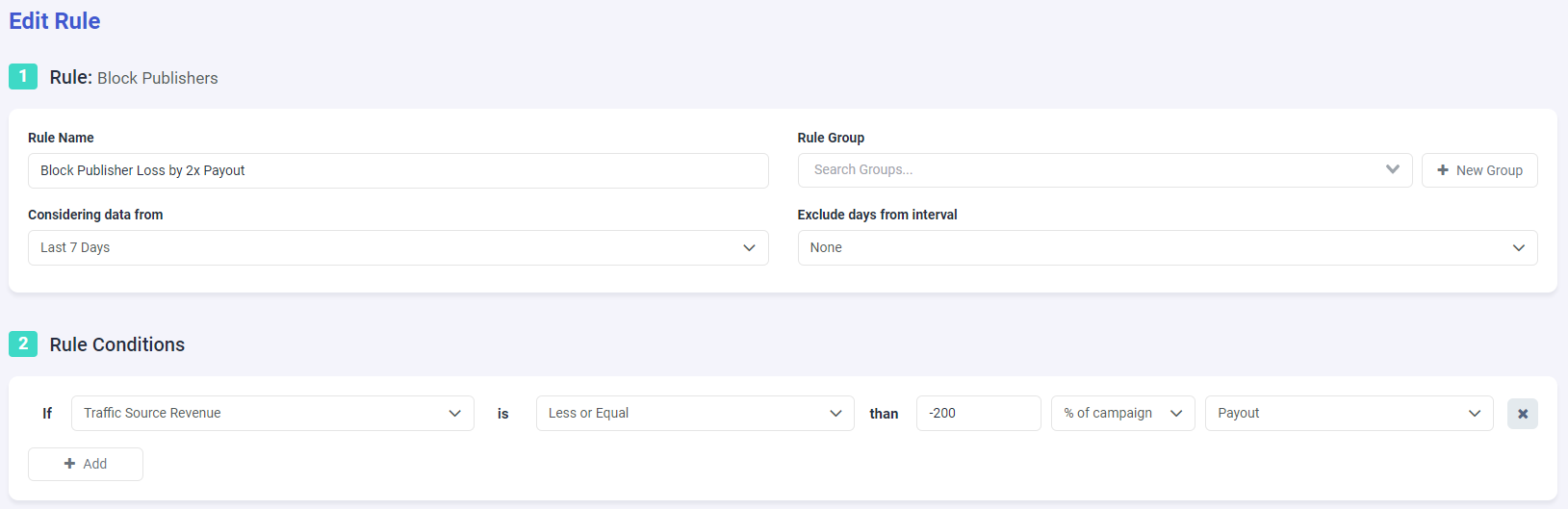
Does this rule already include the rule "block placement spent by 2xpayout without any conversion" I think it is the same right or do I miss smth ?
@vortex: Am I correct that instead of using the overkill "kill/whitelist formula", the rule "block placement if it's in loss by 2xpayout" can be considered a rough alternative which also can cut bad placements with and without conversions. I remember in your post "How-to-Cut-Placements-Landers-and-Banners-Part-2" you mentioned one of the advantages of this method is that it can cuts bad placements which already have some conversions while the rule "2xpayout without conversion" can not deal with that case.
When should I start using this rule, I think if I start applying this rule too soon, it will cut placements which is bad not because of the placement itself but due to other factors like carrier/OS ...
There are few difficulties with the rule.
1. You have to postback click ID and conversion value to the trafficsource.
When you don´t postback any conversion info to the trafficsource it won´t work.
2. The trafficsource doesn´t know the campaign payout, it only knows the conversion value when you get a conversion.
With no conversions a zone could spend $100 without getting blocked.
A better rule would be

There you check the tracker profits so that the rule will also work without haveing to postback conversions to the trafficsource.
The 1.111 needs to be changed then to 2 times offer payout.
So when offer payout is $0.50 the rule would block any placements that are $-1.00 in loss, no matter if they have conversions or not.
It´s not important in 99% of all campaigns, at least for me.

When you don�t postback any conversion info to the trafficsource it won�t work.
2. The trafficsource doesn�t know the campaign payout, it only knows the conversion value when you get a conversion.
With no conversions a zone could spend $100 without getting blocked.

How about this similar rule below in which I replace "tracker profit" by "traffic source profit". The reason I want to do this is because in one of @vortex 40-day tutorial post she mentioned that the cost postback from traffic source to the tracker is not correct and the best way to cut correctly is using the revenue from the tracker and cost from the traffic source.

@leewyhertlein
When working with the traffic source side of statistics, you have to keep in mind that the revenue and conversions should be posted back to the traffic source.
If you are already doing that, then a simple rule to block placements at 2x payout should be like:
IF Traffic source spent is greater or equal to $XXX AND Traffic source conversions are less or equal to 0
Alternatively you can use:
IF Traffic source profit is less or equal than $-XXX
$XXX should be the 2x payout value.
Another alternative if you already have conversions in your campaign and you have the payout reported back to TheOptimizer (or you have set it manually), you can use a rule like:
IF Traffic source profit is less or equal to -200% of campaign payout.
or you can use
IF Traffic source spend is greater or equal to 200% of Campaign payout AND conversions are less or equal to 0
My suggestion would be to use conversions information from the tracker side, combined with the traffic source reported spend.
Also, if you are using landing pages, you can as well block placements at 1x payout without landing page clicks or extremely low lander ctr.
Sent from my iPhone using STM Forums
I forgot to add the minus
Edited the image already.
But yes, when you do it that way then your rule works.
Nonetheless it won´t work that accurate when you run several offers with different payouts or when your payout gets increased/decreased and you don´t update it then manually.
Anyway, I guess everyone has it´s own ways to deal with such stuff

Should you run campaigns where you don´t send conversion info back to the trafficsource it won´t work.
But when you use "Tracker Profits" in Optimizer then Optimizer grabs the revenue from the tracker and the real cost from the trafficsource so these numbers are accurate.
[img]https://i.gyazo.com/7ee15456c74a4566717ed95e20026860.png[/img]
I applied this rule today to my push campaigns and it blocked many of my placements (more than 10). So I became nervous and were afraid I may be doing something wrong. Do you think this rule is only applicable to campaigns using CPM bid model to avoid cost bleeding for placements with higher number of impressions but no conversions. I'm using CPC model for my push campaigns and I think it doesn't matter how many impressions I have, I will not be charged if there is no bid. So it's not necessary to apply this rule right ? Is there any other issue I need to consider when applying this rule
Originally Posted by leewyhertlein
For instance on pop traffic you get charged for impressions, and when running a low payout sweeps offer (that will probably have a conversion rate of around 1%) you have to keep both impressions and lp ctr under the radar in order to be able to make the campaign sustain itself, then profit. But when running push traffic, often bought with a CPC model, a similar rule like the above doesn't make much sense.
In addition, between pop and push there's an additional step in the visitor flow, so keep that in mind too.
Do a calculation of how many push clicks you can tolerate without landing page clicks based of your actual payout and cpc. This should make things easier.
Hi guys: I want to increase bid for individual zones by applying rule below (I copied this rule from vortex outbrain tutorial). However that rule only guarantees that there is at least 30% ROI for each zone right ? It doesn't guarantee that I will get more profit. There is always the case when I increase the bid, I will get more conversions but the overall profit reduces. So is there any rule to monitor the profit and stop increasing the bid when the profit decreases. Actually I'm very confused at this profit thing and have multiple questions circling my head like:
- Should I monitor the daily profit and stop increasing bid when the today profit is lower then yesterday profit.
- Should I monitor for few consecutive days, calculating the average profit before deciding to stop increasing the bid
- Should I compare the today profit with the average of the last 3 days/7days.
...
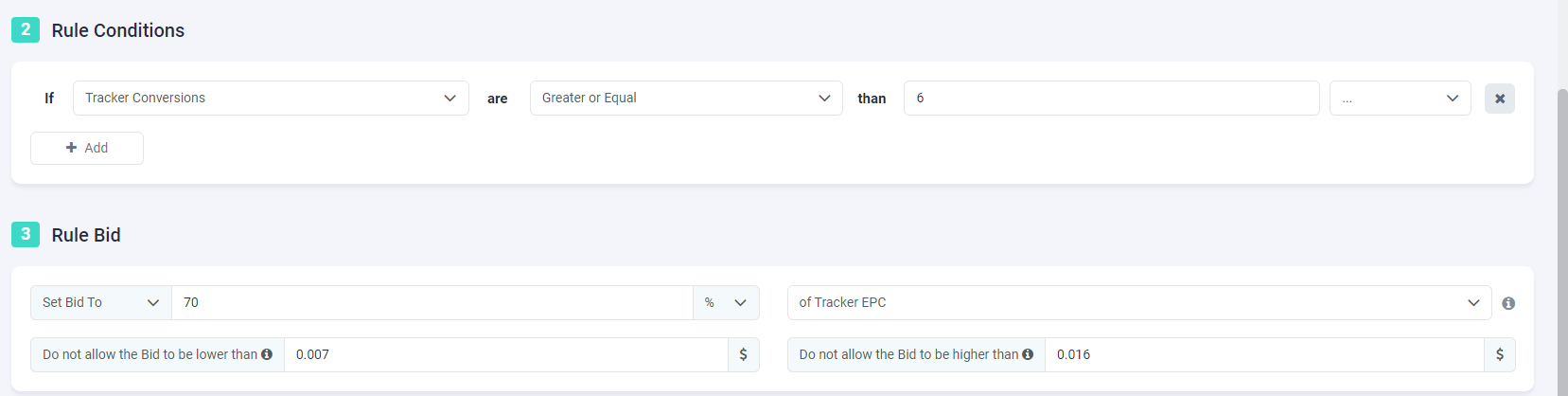
Very confusing, so please help me to clear up this profit thing when applying custom zone bidding.
Originally Posted by leewyhertlein
Anyways, if I properly understood your goal, you should go for a rule like this:

Check my thread about it HERE
Apart from that I see it similar to what platinum said "sometimes you have to sacrifice a bit on the profitability in terms of % while getting a higher net $ even though as a result of a higher spend."
You should do it exactly the other way around.
When you have a placement with good volume, many conversions and high ROI then you shouldn´t decrease the bid but rather increase it.
You want to get as much volume from such placements as possible and not lower volume just to have few % better ROI.
Setting the focus on highest ROI possible only makes sense when you run on low volume.
When you want to scale it´s absolutely normal to run at lower ROI.
At one point the profit from running high volume on lower ROI will surpass the profit from running high ROI at low volume.
Thanks guys for very useful advices. I applied the rule to scale my current campaign. However when scaling this way I came across the following situation"
1. Increasing bid of individual zone only get more traffic for that particular zone but doesn't open up new zone.
2. So in order to open up new zones, I created a new campaign with higher bid. However by doing this I will create an internal competition between two same zones, one in the original campaign with a higher customized bid and one in the new campaign.
So for this new campaign, what should I do to avoid this internal competition ? Should I black list zones whose bid are already automatically increased in the original campaign.
@platinum: Can you clarify what I understand about parameters in theoptimizer mobile below is correct or not
Traffic source impression: the number of lander impression in Pop or the number of creative impression in Push.
Traffic source click: the number of clicks on creative in Push. Not sure if this parameter is available in Pop ?
Traffic source CTR: number of creative clicks/number of impression (in Push). This parameter is not applicable in Pop
Traffic source conversion rate: number of conversions/number of creative impression (in Push) or number of conversions/number of lander impression (in Pop)
Tracker Clicks = Traffic source click - Click loss in Push. Also not sure if this parameter is available in Pop
Landing Page Clicks: number of clicks on landers, the same for both push and pop
Landing Page CTR: the same for both push and pop, number of lander clicks/number of lander appearance (either via creative click in push or impression in pop).
Tracker CTR: ??
Tracker Conversion Rate: Number of leads/??
Originally Posted by leewyhertlein
- Traffic Source Impressions = Reports the number of ad impression served (for Push) or number of landing page impressions served (for Pop/Redirect)
- Traffic Source Clicks = Reports the number of ad clicks as reported in the traffic source
- Traffic Source Spent = Reports the Ad spend amount on campaign, publisher or ad level (depending on the traffic source)
- Traffic Source Conversions = Reports the number of conversions reported by the traffic source (either posted via S2S or pixel). Metric not available if no conversions are posted back to traffic source.
- Traffic Source Revenue = Reports the revenue generated by the conversions reported on the Traffic Source. Metric not available if no conversions are posted back to traffic source.
- Traffic Source Earning per Click = Reports the Earning per Click based of the Revenue reported on the Traffic Source - [Traffic Source Revenue / Traffic Source Clicks] - Metric not available if no revenue is posted back to traffic source.
- Earning per Impression = Reports the Earning per Impression based of the Revenue reported on the Traffic Source - [Traffic Source Revenue / Traffic Source Impressions] - Metric not available if no revenue is posted back to traffic source.
- Traffic Source CTR = Reports the ad click % ratio for Push traffic - [Traffic Source Clicks / Impressions] - Metric not available for Pop/Redirerct traffic.
- Traffic Source Conversion Rate = Reports the conversion % ratio for Push or Pop/Redirect traffic - [Traffic Source Conv. / Traffic Source Clicks] or [Traffic Source Conv. / Impressions]
- Traffic Source Profit = Reports the net profit reported by the traffic source - [Traffic Source Revenue - Traffic Source Spent] - Metric not available if no revenue is posted back to the traffic source.
- Traffic Source Cost per Action = Reports the Avg. Cost per Action (Conversion event) on the traffic source - [Traffic Source Spent / Traffic Source Conversions] - Metric not available if no conversions are reported back to the traffic source.
- Traffic Source Cost per Click = Reports the Avg. Cost per Click (Push traffic only) on the traffic source - [Traffic Source Spent / Traffic Source Clicks]
- Traffic Source Cost per Impression = Reports the Avg. Cost per Impression on the traffic source - [Traffic Source Spent / Traffic Source Impressions]
- Total Budget = Reports the total budget amount allocated to a specific campaign - Value can be changed when available depending on the traffic source
- Daily Budget = Reports the daily budget amount allocated to a specific campaign - Value can be changed when available depending on the traffic source
- Bid = Reports the campaign or publisher bid set to a specific campaign or publisher or ad - Availability depends on the traffic source
- Tracker Clicks = Reports the number of recorded campaign link visits tracked by the tracker. (some trackers call this metric Clicks, some call this Visits - depends on the tracker)
- Tracker Conversions = Reports the number of tracked Conversions recorded by the tracker
- Tracker Revenue = Reports the revenue generated by the conversions recorded by the tracker
- Landing Page Clicks = Reports the number of LP Clicks recorded by the tracker
- Tracker Earn per Click = Reports the Earning per Click based of the Revenue reported on the Tracker - [Tracker Revenue / Tracker Clicks]
- Tracker CTR = [discontinued - don't use]
- Tracker Conversion Rate = Reports the conversion % ratio based on Tracker recorded visits - [Tracker Conv. / Tracker Clicks]
- Tracker Profit = Reports the Net profit based on Traffic Source Spend and Tracker Revenue - [Tracker Revenue - Traffic Source Spent]
- Tracker ROI = Reports the ROI calculated based on Traffic Source Spend and Tracker Revenue - [ (Tracker Revenue - Traffic Source Spend) / Traffic Source Spend ]
- Tracker Cost per Action = Reports the Avg. CPA based on Traffic Source Spend and Tracker Conversions - [Traffic Source Spend / Tracker Conversions]
- Tracker Cost per Clicks = Reports the Avg. Tracker Cost per Click (campain visit) - [Traffic Source Spend / Tracker Clicks]
- Hour of Day = Refers to the Hour of the Day or Day of the week used in a dayparting schedule of a rule
- Payout = Payout value automatically calculated based on Tracker Revenue and Tracker Conversions - [Tracker Revenue / Tracker Conversions] - Value can be manually set

but today I came across the following situation: The traffic source revenue is different from tracker revenue (4.8$ instead of 9.6$) as illustrated in the figure below, which result in a placement loss instead of profit. Actually the loss is so high that it is higher than 2xpayout and gets cut. So my most converted zone get cut accidently which is quite a dangerous situation.

My question is: How the traffic source revenue can be different from tracker revenue. I do set postback from tracker to traffic source and as you can see in the above figure, some placements have the same tracker and traffic source revenue, and some have different values. How can I avoid this situation in the future.
One more thing about this particular zone. Although this zone gets the most conversions (14) in one campaign, it get blocked by another rule (Block if there are more than 100 impression and no LP click) I set up below in another 2 campaigns (one in the same GEO and one in another GEO)
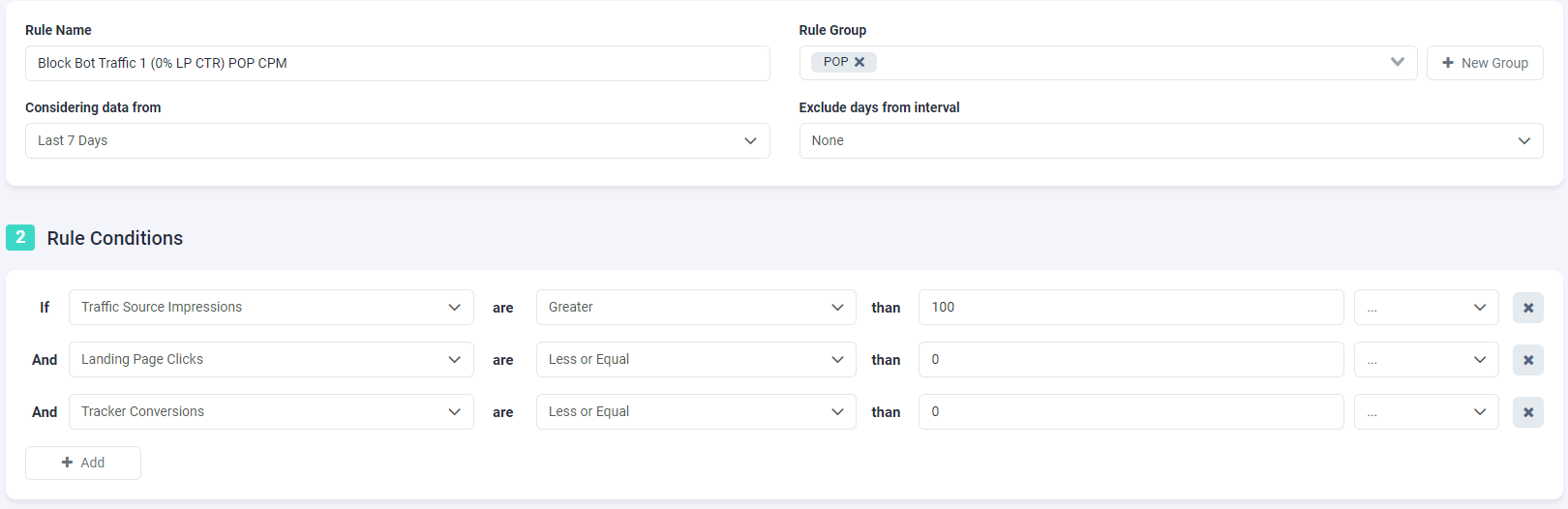
So how should I interpret this zone ?
@platinum: When finishing the above post, I think I found out the reason why the TR and TS revenue are different. I think the reason is that I cloned the campaign in the TS yesterday but still keep campaign in the TR. So theoptimizer report the TR revenue from the beginning but the TS revenue from the day I cloned the campaign. Does it make sense ? And because I cloned the campaign quite frequently to refresh the push/pop campaign, what shoud I do to avoid this situation in the future ?
I still looking for your comments on this question "So how should I interpret this zone ?"
@anhka1990 man you got to check your tracking setup. Most probably you're loosing something in your tracking setup that's not reporting conversions correctly.
Even in the event of running cloned campaigns, your tracker should send the conversion information to the correct campaign using traffic source unique click id / external id.
Also, when you use a tracker I'd recommend using TR Profit, tends to be way more reliable.
Regarding your rule that blocks the converting zone: Are you using any landing pages, or just direct-linking? What's the flow the user goes through?
In case you are not using landers for this campaign, and your rule is set to simply block based on LP Clicks or LP CTR without taking into consideration the conversions, the it's obvious that the zone will be blocked.
I'd suggest adopting your rules according to your campaign funnel and anything else related to it.
On the third day I cloned the T1 to T2, stop T1 and got another 4 conversions on T2. However at this point the campaign A will record 8 conversions (4 from T1 and 4 from T2) but cloned campaign T2 only records 4 conversions. At this point the revenue in theoptimizer start shows differently because TR revenue shows the revenue for total 8 conversions but TS revenue only shows revenue for the current running TS campaign which is T2 and this T2 only got 4 conversions.
Do I miss smth here ?
Originally Posted by anhka1990
- Server-to-server conversion tracking
- Pixel tracking
Both methods utilize some sort of unique impression/visit or click ID that follows the visitor throughout all his journey from ad click to conversion.
The 2nd option nowadays may represent some limitations due to IOS14.5 privacy update, so let's stick with the first option, that of using S2S conversion tracking (which tends to be more error prone and reliable in most cases).
For each click or visit you get into your tracker link from a campaign, using tokens/macros, the traffic source will dynamically add the unique identifier to the respective URL tracking parameter.
This parameter gets stored on your tracker's database, then when a conversion is fired from the affiliate network towards your tracker, this last one will fire back to the traffic source the respective unique identifier to tell it that unique id XYZ generated a conversion.
Having the traffic source unique id stored in its database, the tracker is able to create a relational reference between the traffic source unique identifier and its own unique identifier generally referred to as clickid.
If your setup is correct, using S2S postbacks, you should get an equal amount of conversions on both the traffic source and the tracker. Then if for whatever reason you're posting duplicate conversions or something like that to the traffic source, you will first need to check how the traffic source reacts to duplicate conversion reporting, as well as troubleshoot your configuration issues to fix it.
Please do keep present that some traffic sources are known to have conversion reporting issues, where either using their pixels or postbacks, they tend to report less conversions that there are in reality. Hence that is why, we at TheOptimizer usually suggest to our users to rely on tracker conversion reporting, rather than on that of the traffic source.
I hope the above makes things a bit more clear for you.
Home > Paid Traffic Sources > Push Traffic