TwinRed (ex DoublePimp) Adult Ad Network (21)
TwinRed is a leading service provider in the digital advertising sector, offering both self-service and openRTB capabilities to its clients. Its proprietary platform was developed over a decade by Double Pimp/Double Impact, allowing clients to have full access to a vast marketplace and an array of advanced optimization features.
Advertisers can bid on online advertising spaces in a real-time, auction-based marketplace and optimize their campaigns easily via multiple targeting features.
TwinReds traffic sources:
Targeting options include: country, region, device type, operating system, browser, IP range, behaviour targeting, specific traffic sources, etc.
Traffic types:
Coming soon:
Publishers are able to monetize their traffic effectively and safely, using TwinRed’s advanced publisher features such as the private RTB marketplace, and full price and media control.
Integration options for publishers: Self-serve, OpenRTB, XML
Payment models for publishers: RevShare, CPM
Payment methods: PayPal, Wire, Paxum
Contact us here regarding any questions or business proposals.

Top Adult Websites Stop Serving Popunders in Chrome. TwinRed has the alternative to it.
What happened?
It has come to our knowledge that the top adult websites (including top 100 Alexa sites), as well as many other medium- and small sized websites in the same industry, have recently stopped serving popunders completely in the Chrome browser due to the Google Abusive Ads Report.
A spokesperson said that the adult vertical is only the beginning of a global raid on popunders.
With up to 60/70 percent of total usage share of web browsers (according to different estimations), Chrome is by far the most popular tool to browse the web on the planet.
It’s very hard to predict exact revenue losses for webmasters who were serving popunders, but it is going to have a serious impact on their income.
What is our response?
Peter Rabenseifner, TwinRed CEO, states:”Google banning popunders as abusive user experiences has been a threat for years within our industry. Since our ad-network was specialized in serving popunders, we took this topic seriously from the beginning and started working on alternatives. The biggest goal, said Rabenseifner, was to offer a revenue stream to our publishers that will help them to substitute the income previously generated by popunders. After carefully considering all options we decided to tailor a solution around full page interstitials for Chrome that are fully compliant with the Better Ads Standards and should generate significant revenues whilst at the same time offering a powerful ad format for our advertisers.”
TwinRed Sales Director, Anna Blaivas, is equally excited about the new format: “We did not only develop this ad-format like other networks did. With my background of working with publishers for years we tried to think further and came up with tailored solutions for the specific needs of each publisher. Via our platform there are a lot of options for customization of this ad-format. Our solution includes disabling popunders from the Chrome browser and implementing the interstitial format where publishers can choose custom triggers, can adjust the layout, the text, close buttons and even add their own branding to ensure a high level user experience. Furthermore we focus on educating our advertisers on how to design their interstitial creatives and landing pages in order to maximise their results from this format. Further developments to the interstitial format include randomizing the position of the exit button and text in order to increase the conversion rates without hurting the user experience..”
What is an interstitial ad exactly?
Interstitial ads are full-screen ads that cover the interface. They appear between web pages during navigation from one page to another and are triggered by user clicks. Interstitial ads are embedded into the user experience of a website. They are very effective and provide a high click-through rate. An interstitial ad page uses the same creative as a popunder and is therefore easy to get started with. It can have a countdown but it is mandatory to provide a dismissal button immediately.
How to implement interstitial ads to your website?
To enable interstitial ads in Chrome on your website, you need to implement our fully Google-compliant script and we will start to monetize your inventory. Full customizable options are available in the backend, so please reach out to your account manager for the full array of interstitial settings.
Contact publishing@twinred.com to get your script today.
How to try our new format?
If you want to be among the first to take advantage of this new format and test Chrome interstitialtraffic, please reach out directly to your account manager or email advertising@twinred.com in order to gain access to our exclusive inventory.

Peter Rabenseifner: Speak to your people more than ever.
Interview on a new reality, new role, new network and new opportunities.
TwinRed CEO, Peter Rabenseifner, interviewed over Skype by Roman Seet from Affpeople.com
New Role
Hey Peter, thank you for taking the time to answer my questions. Let me begin by asking you what are your current responsibilities?
My pleasure, Roman. In October last year I took over the ad-network Double Impact, which meanwhile we improved and rebranded to TwinRed, as a CEO.
May we briefly touch the reasons behind your decision to leave Traffic Stars and join TwinRed?
My long-term vision with TrafficStars was different to the vision of the shareholders, so we decided to move on in different paths.
As the CEO did you have to re-build everything from scratch?
With Double Impact I took over a company with lots of potential and strong technology, so not everything had to be rebuilt but rather improved.
We restructured the company, introduced effective processes, hired great talent and rebranded the network to what gives us the basis to be the solid, modern company we are right now, TwinRed.

It is in fact my second role as CEO, after TrafficStars. The foundation of every company are the people, so my first step was to travel across all offices in Budapest, Luxembourg (where our company group is based) and Los Angeles to meet everyone in person and have as many personal conversations with the people who built this network as possible. Only after carefully taking into account all the feedback I started preparing a strategy that will bring long-term success to TwinRed.

New Network
Tell me a bit about TwinRed.
TwinRed is an adult ad-network with self-serve and open RTB capabilities. We manage traffic from popunder, interstitial, banner- and video ad spots at the moment and are planning to launch native ads and push very soon.
We currently are around 35 people across 3 offices: management and sales in Barcelona, IT and finance in Los Angeles and another IT team in Budapest.
Our mission is to be the ad-network of the industry that is known for solid technology, quality traffic and efficient support.
I strongly believe that as a human being it’s important to always remember where you come from, equally important are these roots for a company.
We still operate on the same technology, kept employees with us that have been with the company since 10 or more years and still partly operate from the Los Angeles office where it all began.
The industry matured significantly over the past 10 years and we wanted to reflect that in a future proof company name and brand which also inherited a part from our past. The TWIN part in our name comes from our previous ‘DOUBLE’ name.
What is improved and different in the new version of the network?
As I said the technology is strong and solid but in such a fast paced industry you need constant innovation and improvements to it which is what we are doing. An indicator of our technology focus is also the fact that the biggest team in our network is the IT team and we have very ambitious plans and visions for the future.
I also mentioned processes before which is why we are much more efficient now in reacting to requests from our partners but also in handling internal matters.
Previously the company was a popunder network which has already changed. These days we monetize a lot of banner inventory, big volumes of video pre-rolls, interstitials (our new format to overcome the Google ban on popunders), besides the popunders.
Last but not least we brought in a lot of talent. Starting up the sales office in Barcelona from scratch gave us the possibility to hire exactly the type of people we need to achieve our ambitious goals. In a short time we managed to attract a great combination of industry veterans and hungry juniors.
Why have you decided to re-brand at all?
Part of it was explained with my previous comments about the industry having matured but also it is important that a brand goes hand in hand with the mission and vision of a company as well as with the people who run it.
Before starting to work on the new brand we held a workshop to define our company values. Who are we, what do we stand for and what are we looking to achieve? Only after our values were defined, we moved on to find our new name, after that the design. That was a very exciting project and I am more than happy with the outcome.
I read that you are connected to LiveJasmin. Can you explain to me the nature of this connection?
We are affiliated to LiveJasmin on a corporate level and they are a strategic partner for us. It is always good to have a strong partner by your side but at the same time our focus is on growing the network in general. We work with all kinds of advertisers and affiliates, even if their product is in direct competition with LiveJasmin. We are an independent ad-network.
New Format
I read that days of popunders in Chrome are counted. But I also heard it before. Many times in fact. Can you explain to me what is happening?
We expected this since many years meanwhile. Google went on a hunt, it seems especially in the adult area, to flag publishers who triggered popunders on their site.
Is that true that the biggest adult websites in the world have already ceased to serve popunders?
Indeed, we are talking about some of the biggest websites in the world that were impacted by this. It actually seems that Google went after the big sites first and foremost as a way to state their policy, and we are confident that sooner or later all publishers will have to deal with this matter.
What are the consequences of not abiding to Google rules?
Google has the ability to ban all advertising spots from a website. Usually what happens is that if a site fails the google review a second time, the ads on the site or the opening of new links get blocked for 24 hours or more which is a disaster for webmasters.
Do popunders contribute to a large part of a web-site revenue? How would you estimate that?
We spoke about that in our latest blog post as well. According to our stats, backed up by wikipedia, the traffic of a website can contain up to 70% Chrome traffic which means the impact is huge.
Since we always had a big focus in monetizing popunder traffic we were probably the first to look for alternatives but we considered all of the attempts to go around the restrictions to be short-term solutions only.
If we talk numbers here, approximately of course, can you give me an idea of how much money a top-5 adult website can lose monthly because of popunders?
I won’t get into financials of clients but to give you an indicator, we are talking about 5 digit numbers of US Dollars per day in advertising revenues for the biggest sites.

I saw you launched a new format as the alternative to pops. It’s called Interstitial Ads. How is that similar?
Our full page interstitial solution is pretty much the only way to substitute the popunder ban on Chrome. It shows the interactive landing page of the advertiser after the user clicks on a link, before being directed to the desired content page.
What is the logic behind it?
Our full page interstitials appear between web pages during navigation from one page to another and are triggered by user clicks. They are embedded into the user experience of a website. They are very effective and provide a high click-through rate. An interstitial ad page uses the same creative as a popunder and is therefore easy to get started with. It can have a countdown but it is mandatory to provide a dismissal button immediately.
You have definitely already run some tests internally. Can you share with us what you have seen? How do users respond to the new format?
Our clients are very happy with the solution we provided. Our advertisers are happy with the performance and conversion rates and as a consequence our publishers are satisfied with the revenues generated.
I believe so, yes. On the short- and mid-term at least. However I can assure you that not a day goes by on which we don’t discuss new ad-formats and innovative ways to improve online advertising for our clients.
I also encourage everyone who reads this to run ideas past us if you like to share. We are always open to suggestions and opportunities.
New Reality
You know that we can’t avoid this topic, do you?
I was surprised you waited so long to come up with it. Seriously speaking it is of course a topic that concerns all of us and I believe that we can all learn from each other in how to best deal with this situation.
Tell me how do you manage your team remotely?
We are in the fortunate situation to work in an industry and with a business model that allows us to work remotely. We switched to home-office already before the official announcement came out and it turned out to work very well.
I believe that communication is key during these days. We communicate a lot via slack but also see each other in video conferences. We have stand-up meetings together to quickly discuss short-term goals and results, all our 1-1 meetings work out well and we even work out together with a fitness coach twice a week over Skype.
What software and services do you utilize to make the workflow smooth?
Just to name a few, we are using Slack, Skype, Teams, Jira, Freshdesk, …
Do you think it is realistic to run a network 100% remotely?
I think it is possible, however my philosophy is still that nothing is better than working face to face, since positive energy in an office can have a big impact on the results. I learned though that giving people the freedom of working from home sometimes is a good option.
First and foremost the mindset is: The show must go on. We still keep recruiting for example, even if we have to train people remotely which is difficult but we made it work. We follow the same goals and we try everything to keep up the positive energy.
I would again point at communication. Speak to your people more than ever.
How did your work change during quarantine?
To be honest I don’t notice much of a change. I feel I have a bit more time to focus since you don’t have these constant chats with colleagues but apart from that I would say I even have the same meeting ratio and working hours as before.
I believe in our industry we are able to avoid mass layoffs. Do you agree with me?
I agree, however if the entire world economy gets affected, everyone will feel it.
New Opportunities
Lastly COVID and its impact on the business.
Since more people than ever are at home and spend more time in front of their digital devices, traffic grew during the past weeks and we also see great performance of cam-, dating-, VOD and games offers. Also we must not underestimate the ban on sports events. The entire sports betting business went down and their users are ready to spend money and are looking for alternatives. Another great opportunity.
Is revenue increasing alongside? In other words are we able to sell all traffic?
Yes we noticed a stable increase of volume and revenue. We always sell 100% of the traffic we manage but since it´s bidding – everyone is welcome to join us and get a part of it.
Negative impact of COVID that you have already noticed?
Some products that require call-centers for their sales showed some slight drops and as I mentioned the sports betting industry got hit pretty hard.
Lastly – how do we make more money together in this new reality we all now live in?
I believe that we move towards an era in which quality of content will become much more important. Products with limited value to the users already started to decline for various reasons and I am certain that this trend will continue.
Apart from that, please create your TwinRed account right away and we will do everything to help you to be even more successful with your media buying or traffic monetisation efforts.
Thank you for your time, Peter.
Thank you, Roman.
Source: affpeople.com
New opportunities in online advertising. TwinRed talk at AVS April 2020
We are happy to share with you a video of the expert talk given by our CEO Peter Rabenseifner at the Affiliate Virtual Summit that was held at the end of April.
The talk focused on new opportunities in the online advertising space and covered two major topics: a new web interstitial ad format as an alternative to pop-under traffic and retargeting cross markets — adult and non-adult.
Key takeouts:
Interstitial ads

- Google recently has started to flag pop-unders as a bad user experience
- Some of the biggest websites in the world have already stopped serving pop-unders
- That is only the beginning of a global pop-under raid, mainstream sites are also on the radar
- Webmasters lose a substantial part of their profits ( around 70% of the visitors use Chrome browser)
- In March 2020, TwinRed introduced Interstitial ads to replace pop-unders
- The full-page interstitial ads are similar to pop-unders but fully compliant with the regulations
- Interstitial ads both work for desktop and mobile devices with similar CTR and performance in general
- Interstitial ads are a fresh yet not-competitive ad format to take advantage of
- Best verticals: dating, cams, VOD, games
Retargeting cross markets
- TwinRed ad network and ad exchange supports cross markets retargeting
- TwinRed uses behavior retargeting that tracks any user behavior on any landing page and collects the data
- Account managers create a pixel depending on your tracking needs
- Pixels can be easily integrated in 3 different ways: js script, image pixel, iframe
- Highly effective for mainstream campaigns — TwinRed allows you to reach your mainstream traffic again on adult sites and use your data twice
- Expensive mainstream campaigns become more profitable
- More complex marketing funnels can be built
- Retargeting on adult sites allows you to use more aggressive creatives and angles
TwinRed is always at the cutting edge of marketing technology and we are always happy to share our experience and expertise with fellow affiliate marketers and everyone involved.
TwinRed team
TwinRed is pleased to announce that we have partnered up with spankbang.com on exclusive terms to sell their popunder inventory for both desktop and mobile, starting from next Monday, June 1st.
SpankBang is one of the most well-established and trusted adult websites in the world and we are truly happy to start working alongside to ensure maximum efficiency for our partners.
TwinRed advertisers can already set up their campaigns to secure their part of this premium traffic. SpankBang popunders (Desktop, Mobile, and Tablet) on 100% exclusive terms.
Top GEOs as follows:

- United States
- Japan
- United Kingdom
- South Korea
- Brazil
- Canada
- France
Please reach out directly to your account manager or email us at advertising@twinred.com in order to gain access to our exclusive inventory.
TwinRed Team
Big interview on traffic monetization and publishers side of an ad network
We continue our series of interviews with TwinRed team members. In our focus today is Anna Blaivas, TwinRed’s sales director who has a special passion for the publishing side of an ad network.
In this interview, we discuss what publishers should pay attention to when choosing an ad network in general and what they should also be careful about. We talk about bot traffic and how to fight it and also why some of the biggest websites monetize their inventory on exclusive terms via only one network. We as well talk about ad formats and their variety: which one should be implemented first and which ones are best adds, in another word, the most demanding.
Anna shares with us how the traffic is monetized nowadays and what happens with the remnant traffic. We also could not skip Google’s global raid on popunders. When Google says jump – the whole industry has to jump – why is that happening?
Give the whole interview a read to learn more insights.
Introduction
Hey Anna!
Tell us first what is your area of expertise? What are you responsible for within the network?
So at TwinRed I’m responsible for all areas of sales, that includes the publishing, advertising, RTB, blacklabel and performance departments, overall we are a sales team of 7 people now. I would say my area of expertise is all things sales, but I have a particular passion for the publishing side.
Tell us also a bit about your career path? How did you find yourself in the industry?
I actually found myself in the industry accidentally, I think the same as many people. I was looking for my next role and got recommended by a friend to TrafficStars, which at that time was a team of around 7 people and needed a Russian speaker to manage the publishing department. I got offered the job at the interview, spent 1 year building up the publishing department from scratch and then got promoted to Sales Director when I managed all the departments.
What are your achievements? What is that that you are most proud of as a professional?
That’s a tough question! I would have to say it’s building things from the ground up, the first time was at TrafficStars and now at TwinRed – building a new client base, new ideas, processes and most importantly a new team!
How is your team doing at this hard moment of crisis? Have you managed to keep all the people ?
Our team is doing very well actually – I have set up “stand up” meetings twice a week so that the team can see each other (via conference calls), share their goals and get some social interaction with other team members. Not only are we working well effectively during this time, but we have actually hired 3 new team members during the lockdown! All the trainings are done via online tools and so far this has been working great for us, and we will continue to look for talented people who want to join TwinRed.
(TwinRed booth during AWA Bangkok)
Publishers
What is the standard checking procedure for any website before it gets inside any reputable ad network?
Our compliance department reviews every single website that gets registered in our system, without giving too many details – they look through everything including content, codes implemented, domain history etc. in order to ensure that we only approve sites which follow our guidelines.
What publishers should pay attention to when choosing a network for traffic monetisation?
Aside from the “obvious” which is strong technology, good customer support and transparent statistics – I would advise publishers to go for networks which have an active bidding system with lots of different clients. They should look at a publisher site that the network works with and see what kind of offers are running on it – if there is a variety, that means the network has a strong advertiser base and will be able to monetise the websites more effectively. I would avoid networks that rely a lot on their internal CPA offers or a few strong advertisers, as that is more risky and does not determine the real value of the traffic.
What should they be careful about?
Following on from my previous point – ad networks that give them very high rates from day 1 and then they see a decrease of the rates slowly. Usually this happens as ad networks try to “lure” publishers in by giving them strong rates at the beginning, often based on their internal CPA campaigns – which is not a “real value” nor is it sustainable.
What kind of control does a publisher have on their end over ads displayed via an ad network?
It depends on each network’s technology and policy. Most networks give publishers a choice between an iframe and JS code (for popunders – direct link vs script) – if they use an iframe / direct link then they pretty much have full control over how ads are displayed. Moreover at TwinRed, even with our script/JS publishers have a lot of settings they can choose such as frequency capping, page views, blocking different geo’s etc.
What if I see ads that are not meant to be on my website? What can I do?
This can happen due to inject / hijack ads and unless the publisher can identify who’s code is running (which can be hard) one of the ways is to one by one switch off all your network providers to find the “culprit” and then provide all details to the network (geo / device / browser etc) so that they are able to identify the issue.
Is that common situation that publishers can try to monetize fake/bot traffic? How often does that happen?
Personally I would say that we are seeing less and less of this as networks become better at identifying fraud traffic both before it is even sent (at site level) and at the traffic level, which makes it harder to monetise bot traffic for a long time. I would say most publishers that try this get caught within the first week.
How do you detect fake/bot traffic from you publishers and what is your response?
Our compliance team has a variety of tools, including our in-house anti fraud system, which help detect fraud traffic with a high accuracy. Our first mission is to always reach out to the publisher to speak to them and understand what is happening before taking further actions.
Why do some of the biggest adult websites try to monetize their traffic via only one network exclusively? Is that for better control?
Most of the top adult websites have their own networks to monetise their traffic in order to have full control and in order to be able to sell their traffic more effectively / safely under their own company.
However websites who simply have exclusive partnerships with networks often do this as it is a more stable revenue stream for them and less “stress” as they don’t have to monitor their rates continuously.
(CEO Peter and Sales Director Anna during AWA in Bangkok)
AD formats and traffic monetization
What ad formats should new publishers consider to implement first?
New publishers should go for the “standard” in order to test all the formats and see which ones they would like to continue with. This includes: banners, native ads, popunders (non-Chrome traffic), Interstitial ads, (Chrome) and video pre-rolls. After they have established some good rates / set up for these formats, they can then start collecting their push database (before starting push notifications) and experiment with video sliders and additional formats such as these – depending on their revenue needs.
What are the most demanded ad formats right now?
Right now we are seeing interstitials and pre roll ads gain more and more popularity as publishers are looking for other formats to invest into due to the Chrome popunder situation.
What countries are easier to monetize now?
Tier 1 is always easier to monetize and especially now during the lockdown.
Can you tell us in a nutshell how traffic is mostly monetized nowadays? Is every click getting sold at auction?
It depends on the network, but a network such as TwinRed aims to sell all the traffic via an auction / Real Time Bidding system in order to determine the right value of the traffic. Our bidding consists of a large portfolio of external advertisers as well as some internal campaigns which compete with our clients. A small percentage is sold at a guaranteed / flat rate to some advertisers – but this is a small amount of the whole traffic.
What happens with traffic that no one is bidding at? Do you still monetize it somehow?
Every network will have some remnant traffic, in our case it goes to our internal campaigns where we put effort into optimising them on a daily basis to ensure that we can generate the highest possible eCPM’s even on this traffic.
I know we have already talked pop-unders many times, still let’s make it clear –
Why do some networks serve pop-unders in Chrome even from websites that officially had stopped serving them?
There could be many different reasons, for example:


- Some websites still did not get flagged (I predict they will get flagged in the next round of Google reviews)
- Some publishers are “hiding” their popunders deep in user actions (i.e. on the 5th click on specific behaviours)
- Some publishers don’t care about getting banned by Google (usually lower quality)
What real sanctions can Google place on publishers for not abiding by the rules?
Google will block all your ads and/or outgoing links for 24 hours, and may be more. Moreover there are always rumours going around that Google could punish disobedient webmasters by harming their SEO placement – whilst this has not been confirmed, many publishers worry about this.
How has it come that Google can control any website on the web?
Google dominates the browser market which a majority share, and for most publishers this is their most valuable source of traffic. Therefore after Google decided to become the Internet “monitor” by pairing up with the “Coalition for Better Ads” we have come to a point where when Google says jump – the whole industry has to jump, or they face losing a very large revenue stream.
What ad formats will be gaining momentum in the near future?
Aside from formats we have already discussed – interstitials & pre-rolls – I think we will see a lot of new variations to the standard ad formats as everyone is now more interested in finding clever ways to increase monetisation. We already see a lot of development going into new ways of presenting pre-rolls, native ads and slider units – variations on the traditional ad formats.
Thanks Anna!
Lastly, where can people find you on-line?
You can find me on LinkedIn (Anna Blaivas), Telegram (annablaiv), Skype and email (anna@twinred.com)
Thank you!
Big interview on building IT infrastructure for a high-load ad network
Today, we have another episode of our series of interviews with TwinRed team members. Our goal is to show you how an ad network operates from the inside out, let you backstage and also show you who stands behind the TwinRed company. At the end of the day, every business is about the people.
In this post, we talk to our CTO Denes Kiss who is responsible for everything that is IT related inside the TwinRed team. That includes managing the developers, QA and internal product ownership, handling server provisioning and maintenance, providing support for both clients and internal requests, defining processes to make the workflows even smoother.
So, go get yourself a cup of coffee and learn how IT infrastructure is built in a high-load ad network with a remote team spread around the globe.
Introduction
Hey, Denes. Can you first of all tell us a bit more about your IT career path?
When I was 13 a friend of mine came by with a book about `Coding in Turbo Pascal`, that point was where my whole career started. A few years later I found myself in a high school trying to sell my very first program which was supposed to help the users to learn touch typing. It never happened, but still motivated me to keep coding and learn more about IT. During university I deep dived into the life of Data Centers as a hosting operator where I learned a lot from industry veterans about IT operations. After many private projects of website coding I ended up in the early era of LiveJasmin as a PHP developer. This was the very first opportunity, where I had the chance to deal with really high-loaded systems. I was lucky to be part of various projects inside the company, like creating a tube site, leading the tech side of AWE (affiliate network) and last but not least creating an ad-network from the ground up.
Following these projects I was honored by the management to take the IT lead of the TwinRed project, where I’m acting as a CTO now.
How do you define your main goal here at TwinRed?
My general main goal is to have a smooth operation and as fast delivery as we can.
Managing remote teams
To begin with, I would love to know how big is the entire IT team that you are supervising?
Our team is about 20 people that includes the developers, QA, Product owners and DevOps.
What are your main IT departments?
As mentioned, we have 4 large areas:
Product owners: When a new feature request lands in our department, they are the ones who are translating business needs into a more detailed technical description, covering edge cases, preparing UI mockups, etc. Also they are the ones who are adjusting priorities and bundling releases to match business deadlines.
Quality assurance: Once a Developer completes their part, the task is queued for the QA team to test and review. QA makes sure that everything works according to the specifications and requirements which were provided by the Product owners. One of their major responsibilities is to make sure that new features do not break and align with existing ones.
IT Operations(DevOps): The behind the scene guys. They provide the right infrastructure to work with, things like provisioning hardware for new features, keep everything up-to-date, providing access to various systems and of course working closely together with the developers on several tasks.
Developers: They are the magicians. Other than programming, they also create architectural plans and documentations, test their own developments and help in to provide top-notch support.
Following this detailed introduction, I must admit I don’t really like to think of them as well separated departments, we are one team. We usually go beyond the strict limits of each job, for example Developers do extensive testing during development, while QA helps the Product owners in many cases, DevOps is often doing some programming and the list goes on. We have collective goals and we help each other to reach these as efficiently as possible.
TwinRed branding workshop: Brandon from Ferras, CTO Denes Kiss, Sales Director Anna Blaivas, CEO Peter Rabenseifner
How is your IT team spread across different locations?
We operate in 3 main locations: US (Los Angeles), Hungary and Ukraine
Do you have any daily check-ins for your employees?
We work in Scrum, which requires daily live sync. However since there is a big time zone difference I cannot keep up with all the colleagues personally on a daily basis. We separated us into 2 virtual teams, one works in the Los Angeles time zone, while the other is based on CET. We have regular weekly calls to keep us in sync, also we heavily use Slack to discuss anything that comes up.
How do you manage and track the progress and outcomes?
Scrum methods give you a handful of practices that help you to track the progress of each task separately, and provides KPIs for tracking team performance. We use Jira for task tracking and release management.
What is your set of tools for effective remote work?
The most important is to have a simple and effective channel for communication. I always prefer face-to-face conversations if possible, because it is faster, more straightforward and more personal. So video-calls and chat are our weapon here.
Also a comfortable chair and desk is a must have.
Last but not least the key for effective remote work is having faith in your co-workers. You have to trust all your team members and let them work without being supervised closely. Honestly sometimes it is hard for me to step back and just let them work.
What are your main obstacles to running a spread IT team?
Our biggest obstacle was the time zone difference, but luckily we managed to get over it with proper communication.
Building and maintaining an IT infrastructure for a high-load ad-network
Speaking of an ad network we always imply extreme load. Am I correct?
You are absolutely right. We are working with extreme amounts of traffic.
Just to give you an idea, we handle requests in the range of 7 figures per minute.
What could it be compared with?
Wikipedia is the 13th page on the top sites list of Alexa. Based on a site review it has around 300 million page views per day. If you do the math, this translates to around 200K requests per minute.
And an ad network can absolutely not face any down time, as I can imagine. Tell me firsthand what are the consequences of 1-hour down time?
Let’s just say having a full hour of down-time is extremely expensive. We planned our architecture and introduced different practices that ensure this never happens in TwinRed.
What is your monitoring system to prevent such consequences? How do you make sure everything is going smoothly?
Testing, monitoring and redundancy.
We thoroughly test each and every development, before we release it to production. This is a must have.
We monitor everything. It is a common problem that many companies only do the monitoring of the tech side, like checking CPU/memory usage, response times, etc. We make an effort to do business monitoring as well. During a release we always look for changing trends in our traffic, this allows us to spot problems earlier.
Redundancy is also a key to prevent downtimes. Hardware failures can happen anytime and our system is designed in a way that automatic failovers make these failures invisible to our customers.
How do you balance the load?
We utilize many network level load balancers that spread the traffic to many servers. As I already mentioned, the key is the redundancy. Multiple load balancers, multiple network providers, multiple everything.
Thank you, Denes, where can people find you online?
Feel free to add me on LinkedIn https://www.linkedin.com/in/deneskiss/


TwinRed is truly happy to announce a number of exciting partnerships with some of the most respected and known websites in the industry.
From now on, TwinRed will be serving pop-unders across desktop, mobile and tablet devices on exclusive terms on the following websites:
- Jizzbunker.com (1.1M daily impressions)
- Xozilla.com (1.8M daily impressions)
- Hdsex.org (2.2M daily impressions)
- Megatube.xxx (250k daily impressions)
The strongest GEOs across these sources are US, DE, UK, FR, IT. This premium traffic converts especially well on dating, cams, VOD, and gaming offers.
TwinRed advertisers can already set up their campaigns to secure their part of this exclusive quality traffic.
Please reach out to your account manager, email us at advertising@twinred.com or sign up directly in order to gain access to this inventory and many other premium ad-spots.
TwinRed Team
Blacklabel and Whitelabel cam solutions. All you need to know. Interview with Tarik B
¡Hola!
Another week, and another episode of our series of talks with TwinRed family members is right here. In our interviews, we both get you acquainted with people who make TwinRed and also tell you how the network is made, what it consists of and why it operates the way it does.
Today, we are talking to Tarik Baad, business development, sales & marketing of Blacklabel and Whitelabel cam solutions with TwinRed.
We noticed strong demand for that kind of solutions with many questions coming along. So, the purpose of this interview is to tell what exactly Whitelabel and Blacklabel cam solutions are, how they are different, how to make profit utilizing them and many more useful things.
If you are a publisher or an affiliate looking for some new ways to generate revenues, here you can find a few good ideas to implement for yourself.
Hey Tarik, a few words about your career path before we start?
Sure. I am an online marketing and advertising professional with more than 15 years of experience in web, mobile traffic monetization. I design creative marketing strategies to help partners generate traffic, and monetize it the best way possible.
In short what are your direct responsibilities within the TwinRed Family?
At TwinRed I am responsible for business development of AWE´s Blacklabel and Whitelabel solutions. I work closely with webmasters of high quality websites and large volumes to help them integrate and optimize these solutions.
What is your professional goal that drives you forward?
As I said during the introduction I am very passionate about the digital industry and the role I play in it but only success is what really drives me. We want to lead the market I work in and this is an ambitious goal that attracted me from the start.
Let’s start with the topic!
Can you firstly help me understand how Whitelabel solutions work exactly?
The Whitelabel is a domain based tracking solution that’s built as a ”ready-to-go” solution for webmasters if they want to set up their own cam site fast and easily. The Whitelabel system uses the infrastructure of AWE and predefined layouts. Nothing is hosted on the webmaster’s server and customization options are limited.
Do I understand it right that a webmaster can keep their brand and website style and the backend will be yours?
Yes and no. Yes, because they can keep their brand and they can choose colors that come close to their website’s style. No, goes with the fact that there is a limit to customizing sites in Whitelabel. There might be sites that won’t be able to choose layouts that look closer to the original sites because the layouts are predefined.
Is that hard to implement techwise?
Not at all, it literally takes a couple of minutes to set up.
Why is that beneficial for a webmaster? Why not to just generate leads and get paid?
It is beneficial for webmasters that don’t want to invest much time and resources in complex integrations and want a high quality live cams as a quick solution that generates revenues for them.
Do you work on rev share bases or any other payment model?
Yes both Blacklabel and Whitelabel are rev share based. With AWE´s solution you get the highest rev shares in the industry.
Curious to know what is the percentage?
The answer to that question would make it easy for the competitors to know how to adjust their strategies. Let me just state that our rev shares are the highest in the Cam industry.
Without disclosing any specific numbers can you let me understand what kind of income can a webmaster with a high quality site generate a month?
The income depends very much on the traffic quality and quantity and the will of the webmaster to promote the Whitelabel/Blacklabel smartly to their audience. But an average decent site can make between 4 to 5 digits a month.
How big should my audience be to be able to make some cash?
The bigger the audience, the better. But that’s not a factor in Whitelabel/Blacklabel because you can do some media buying to push your Whitelabel/Blacklabel and generate sales hence good cash.
Do you have different cam products? Let me know what audience can I find the right product for?
AWE has different Cam products indeed to give the webmaster the variety of options to promote what goes in hand with their content.
Worth mentioning that, upon setting up the Whitelabel, the webmaster can further customize categories and target more specific niches.
I have started recently to hear more and more about Blacklabel solutions. Can you help me to get my head around? How is it different from the Whitelabel options?
The Blacklabel is way different from the Whitelabel and it actually out performs the Whitelabel in many aspects.
The Blacklabel is a fully flexible API, which enables website owners to add LiveJasmin’s highly acclaimed Live Cams directly into the webmaster’s tube sites.
We provide the webmaster with all the components for the integration, allowing them to grab each function and feature of our services separately without being tied to any predefined layout/design.
Unlike the Whitelabel, users no longer have to leave the webmaster’s site for another domain to enjoy a premium cam show. When they click on a live cam tab they stay on site and they never leave.
Unlike the Whitelabel, the Blacklabel gives the webmaster full control of the layout and the SEO.
And in terms of money is Blacklabel more profitable than Whitelabel?
It is indeed. Factors like the seamless integration as well as the 1 click flow payment make it out-perform the Whitelabel.
What are downsides of implementing Whitelabel or Blacklabel solutions? Can it be contrary to any current monetisation on a website?
The question is tricky as both solutions stand above on their own. Yet, Whitelabel and Blacklabel themselves have pros and cons. Whitelabel is fast and easy to set up and doesn’t require any tech resources to implement but you don’t have control of the SEO, layout & design, and you have no control of the audience.. Whereas the Blacklabel’s cons are the requirement of advanced tech knowledge to implement, many compliance bullet points to check but you have more control of SEO, design and layout, and you have total control of the audience and their information.
I wouldn’t put Blacklabel and Whitelabel on a competition podium with other monetization tools because they are way different and they complement the other promo tools like banners and pre-rolls. For example, I urge webmasters to use banners and sliders to promote the Whitelabel/Blacklabel to generate more revenues.
Any specific requirements to integrate Blacklabel to a website?
The Blacklabel has requirements because of its technical and business weight.
For webmasters who have sites using kernel-video-sharing (KVS) script for video streaming we can integrate them easily because KVS has developed a solution to integrate our Blacklabel easily but only sites using KVS script.
Besides having the technical knowledge to integrate the, the webmaster needs to have: :


- HTTPS protocol
- GDPR compatible Privacy Policy
- Cookie policy
- Over 18 agreement – on live chat page and registration page
- Adhere to our integration guidelines
- Include our Privacy Policy within the live chat player
- Sign the Blacklabel IO .
Our partners must have a Privacy Policy page which contains all the information required from Art. 13 of the GDPR.

Can we then conclude that the future is for Blacklabel solutions?
I bet it is indeed. The Blacklabel offers the webmasters the opportunity to run their own Cam site section on their own tube sites with all the features and characteristics a quality cam site can offer.
They get the SEO control, the design control and more interestingly the audience control. Just imagine how much a webmaster can do with so much information in their grasp.
Oh wait, I forgot to mention the 1 click flow payment. Yes, we offer this payment method to users, so imagine how easy paying for the Live shows is when the user has to click only once to purchase credits to keep chatting and enjoying the Cam shows with no interruptions.
For anyone who is interested to monetise their website with Whitelabel or Blacklabel cam solutions how they can reach out to you?
Anyone interested in knowing more about Blacklabel and Whitelabel or got traffic and aren’t happy with the revenues they are making and want to make more can holler at me by email: tarik@twinred.com. I usually answer at the speed of Google’s search prediction bots…
Here my Linkedin and Telegram: @Tarikbaad
Chrome’s heavy ads intervention is coming into effect. Chrome developers announced the heavy ads intervention on Maу 14th, and now it’s being gradually rolled out.
“The core idea of Heavy ads intervention is to combat ads that consume excessive amounts of bandwidth and CPU usage on user’s phones and devices and prevent them from loading in the first place.”

According to Chrome developers, only 0,3% of ads account for 27% of network data used by ads and 28% of all ad CPU usage, these ads may be poorly optimized, or downright malignant to users. So to improve user’s experience and define “Heavy ads” that will be unloaded, Googles developers came up with the following criteria:
If the ad’s creative,
- Used the main thread for more than 60 seconds total;
- Used the main thread for more than 15 seconds in any 30-second window (50% utilization over 30 seconds);
- Used more than 4 megabytes of network bandwidth to load resources.
Then it is to be considered “heavy” and will be blocked and not shown.
Most of the possible subject creative-types are hosted within iframes:
- interstitials;
- iframe banners;
- pre-rolls.
"As previously said, this feature was set to be released in August with Chrome 85, but it is only being rolled out now. Right now not all of Chrome’s users are affected, but eventually, this feature will come as default in all of the browsers. This measure may cause some discomfort for those advertisers who use creatives that are overfilled with the content or poorly-optimized and thus can be considered “heavy”.
With the help of the “Google Non-Compliant Heavy Ads” tag publishers and site owners will be able to opt-out of showing said ads. As for advertisers, your medias can be tested by following instructions by Google. If you have any doubts, you can always reach out to your TwinRed account manager or send us an email to support@twinred.com.
|
||
|
||
|
||
|


Nice, so you have the native format too now. Is that mostly adult traffic too, or did you expand into the mainstream markets too?
 Originally Posted by matuloo

On TwinRed side the traffic sources are fully adult, however we see more and more mainstream advertisers such as casinos, nutra, crypto, anti-virus products etc. promoting their offers on our traffic.
Mainstream traffic is, based on the same technology, available through our sister company AdSupply.
Originally Posted by twinred

| Interview on RTB – basics that everyone should know |
||||
 |
||||
| Hello! The time has come, and we are continuing our series of interviews with the members of the TwinRed team. This time we are talking to Mariia who is responsible for RTB integrations, so if you were ever wondering how does it work and what advantages and challenges Real-Time Bidding brings to an advertising network – you are in the right place at the right time! |
||||
| Tell me what you are exactly responsible for? What does your remit encompass? In TwinRed I am responsible for the RTB (Real Time Bidding) integrations. My responsibility is basically to buy and sell traffic via RTB and XML integrations and match the best traffic to the right demand, across most formats. For those who never heard about RTB, can you explain how that works basically? As I have already mentioned, Real Time Bidding technology allows to buy and sell impressions in the form of an open auction. I have Advertisers (DSPs) integrated on one side and Publishers (SSPs) – on the other. Publisher’s traffic converts into bidding requests that are sent to the TwinRed Ad exchange. These requests contain different types of data, such as geo location, browser, sometimes even demographic data. The TwinRed adexchange then passes these bidding requests to its advertisers. The Advertiser who bids the highest amount wins and their ads are instantly presented on a publisher’s website. |
||||
 \ \ |
||||
| There are XML and RTB protocols – what’s the difference between them? The process of impression buying and selling is identical – Real Time Bidding. The difference is the format of a request/response : JSON (JavaScript Object Notation) VS its alternative XML (eXtensible Markup Language) . Which formats can be sold through RTB? Currently via oRTB we are selling/buying popunders, pre-rolls, banners. Push notifications and popunders are also available via XML. We are also working on making available our native ad solution via RTB. What kind of partners do you work via RTB? Are those only networks? We keep the number of Networks limited collaborating only with trusted partners, whose traffic we tested and we know the quality. Our RTB advertisers are both direct advertisers and networks, willing to buy high quality inventory for the best possible price. We have a lot of demand connected already and are open to connect more but the focus is on quality advertising rather than connecting random partners. |
||||
 |
||||
| Why would a network work with you and sell their inventory via your RTB solution? What are the advantages? The advantage is the possibility to sell their Adult inventory for the best possible price since we have big advertisers in the platform that will be competing for the spots in the open RTB auction. We work with trusted partners and have strict compliance guidelines, so publisher’s can rest assured that not only they will get the best price for their traffic but also clean advertising Can you describe the process of integration so everyone can understand it better? Sure! Sometimes, our potential partners reach us via different channels. Sometimes, I am contacting the network we would like to be partners with. In the beginning I ask our potential partners to fill in our integration questionnaire, where they provide the basic information of their network: technical information, their formats, their top geos, samples of the Adult inventory etc. I usually ask for the sample of request/response to evaluate whether we are technologically compatible: in 99% of cases we are. Based on these responses we prioritise next integrations depending on our needs and technical compatibility. When we start I usually create a test set-up, to check if the integration is properly working. Also I check the level of discrepancy we have between the platforms. If everything is working properly we sign the IO and start working. We test the feed with a limited QPS (query per second) for some time.If afterwards everyone is happy, which is 99% of the time, we scale. Is discrepancy a big issue for you? I would not say it is a big issue . But it is something we always should look into with partners, understand what causes it and find ways to minimise it. What discrepancies in % is appropriate to have? I believe the industry standard is 10% and in the majority of cases we are below that so we are able to effectively scale with our partners with no risks. We have extensive support from our technical team and we optimise all the integrations from the very beginning. We tend to take care of all the minor issues (filters, mismatches…) in order to keep the level of discrepancy as minimal as possible. What are the main obstacles and difficulties in the integration process? I believe, aside from technology, we do not have any. We all work based on the standard oRTB protocol, however, each platform might have its own peculiarities and from time to time we can not process request/response correctly. But our TwinRed developers can adjust the system. It can take some time but we already created several customised response types to be compatible with other platforms. Roughly speaking what % of your inventory is sold via RTB? Currently around 20% of our revenues are coming from RTB advertisers. Revenue from the RTB Supply side represents an even bigger percentage. Do you see RTB differently in mainstream and adult? I believe, yes, since with adult we should be much more cautious. We are putting more effort into checking the inventory and networks where the ads from our Adult advertisers are being exposed. |
||||
 |
||||
| Why do you need to be more cautious? Any network working with RTB has to be more cautious as it’s harder to check the compliance of RTB partners since everything happens in real time. That’s why we have developed extensive procedures, from signing an IO with strict compliance clauses to using different compliance tools in order to minimise this risk What do you need to pay special attention to with adult ad suppliers? Even before going into a business partnership with a DSP partner, we make sure that compliance rules have been exchanged and agreed on. We sign an IO which outlines our rules so each partner we connect is fully aware of our strict guidelines and knows the repercussions of non – compliance. To keep our demand as clean as possible we use various tools to constantly check ads and immediately flag anything that does not comply with our advertising guidelines. From the Publisher’s side – Our compliance team and I check the domains of the feed and block the inventory that is not compatible with our quality standards. If the Network is not passing us domains, we monitor the performance of the inventory very carefully and keep only high quality sources. That is why we select partners for both sides wisely. Does that happen that someone might want to sell bot traffic via RTB? Yes, this may happen in any industry. From time to time multiple networks may try to squeeze bot traffic into the feeds, but due to our system of internal checks and processes which evaluate traffic quality – we are able to spot this as soon as possible and stop working with such partners if such cases arise. How do you fight that kind of fraud? As I have mentioned before we choose only trusted partners and establish relationships with them based on trust, however, we have several layers of checks in place from testing the traffic, compliance checks on the traffic, contracts in place and other tools which help us identify fraud immediately and stop working with such partners. Thank you, Mariia! Thank you, Roman, that was a pleasure to talk! |
||||
| What we’ve been up to so far |
 |
The first half of 2021 is drawing to a close, and it’s time we look back at what we’ve accomplished. It may come as a surprise to some of you, but even in a half of 2021 TwinRed added more ad-formats and features than ever before. |
 |
One of the biggest implementations of the year was the addition of new advertising formats: Native ads and Web Push Notifications. Now advertisers have an even wider selection of advertising inventory in a variety of formats. That way everyone can find a marketing opportunity in TwinRed. Additions don’t stop there, we’ve also added more than 50 new sites to our inventory, so you can reach a broader audience and have enough volume for your scaling needs. With new formats and larger inventory, it seems reasonable to make sorting and researching best-performing placements easier and that’s just what we’ve done. With our inventory-sorting feature you can quickly discover the best-performing sites, so you have a head start on your black (or white) lists. |
 |
Even the most advanced features can dazzle some of us, so we made sure that our support team is always just a few clicks away with the help of a live chat feature added to the website and user interface. |
 |
To bring you even more value we’ve launched a weekly newsletter, in which we share insights from our team, publish the best practices, keep you in the loop on the latest developments in TwinRed, and share life hacks and tips used by other advertisers. It’s worth a read, so check it out! There are even more things “in the oven” so sign-up to our newsletter not to miss out on updates and features that can up your ROI and give you a better idea of what’s going on in the world of affiliate marketing! |
| Hello, STM members! We are looking for an experienced performance marketing manager/media buyer to join our amazing team in Barcelona or remotely! Please, find more information below or visit twinred.com/career |
 |
 |
 |
| twinred.com/career |
 |
| Hey guys! In our latest blog post we have collected the most common acronyms that are crucial for the affiliate marketing industry. No matter if you are an aspiring affiliate or an experienced one, you have probably come across various acronyms which are quite difficult to understand. We put them into five groups and explain: General Terms; Pricing Models & Payment Schemes; Targeting; Traffic Analysis; Others. Let’s dive into it! |
| Link: https://www.twinred.com/news-insight...ting-glossary/ |
| Native is Reinvented. TwinRed Launches Native Rotate Ad Format |
 |
| We created a format where native meets interactive storytelling! Lure your users in by showing a narrative when they hover. Available only at TwinRed. |
| At TwinRed, we care about your campaigns and most of all we care about your profit. |
| To serve you better, we never stop evolving and improving. In recent months we’ve been working hard to bring this innovation to market and we are thrilled to announce the all new format variation – Native Rotate: the new innovative way to tell stories with your native ad and convert like never before. |
| Proudly invented at TwinRed |
| What is Native Rotate? |
| Native Rotate is a new spin on the traditional native format, containing multiple images (up to 10) that are rotated upon user interaction in the order that you set. |
| When a user hovers over an ad unit, your slideshow of images begins to cycle. The slideshow continues to loop as long as the user remains hovering. |
 |
| How can you utilize Native Rotate to your profit? |
| The possibilities are really endless. Keeping all the advantages of static native ads, Native Rotate ads give you the space and freedom to create and design as never before. |
|
| Native Rotate is supported both on mobile and desktop devices and its options are limitless, all depending on your creativity and imagination! |
| How to set up your first Native Rotate campaign |
Enable rotate image when setting up your native ad campaign Upload up to 10 images (we recommend to use 5) Arrange them in the order that they should be displayed Launch! |
 |
| Note for publishers: You don’t need to do anything. |
| Native Rotate is just an option on our existing Native media source type; there is no new action required by the Publishers to run this display besides the traditional Native / Native complete setup for their zone. |
| Should you have any more questions or need any guidance, we will be more than happy to walk you through it. |
| TwinRed Team |
| How to use macros and how they work |
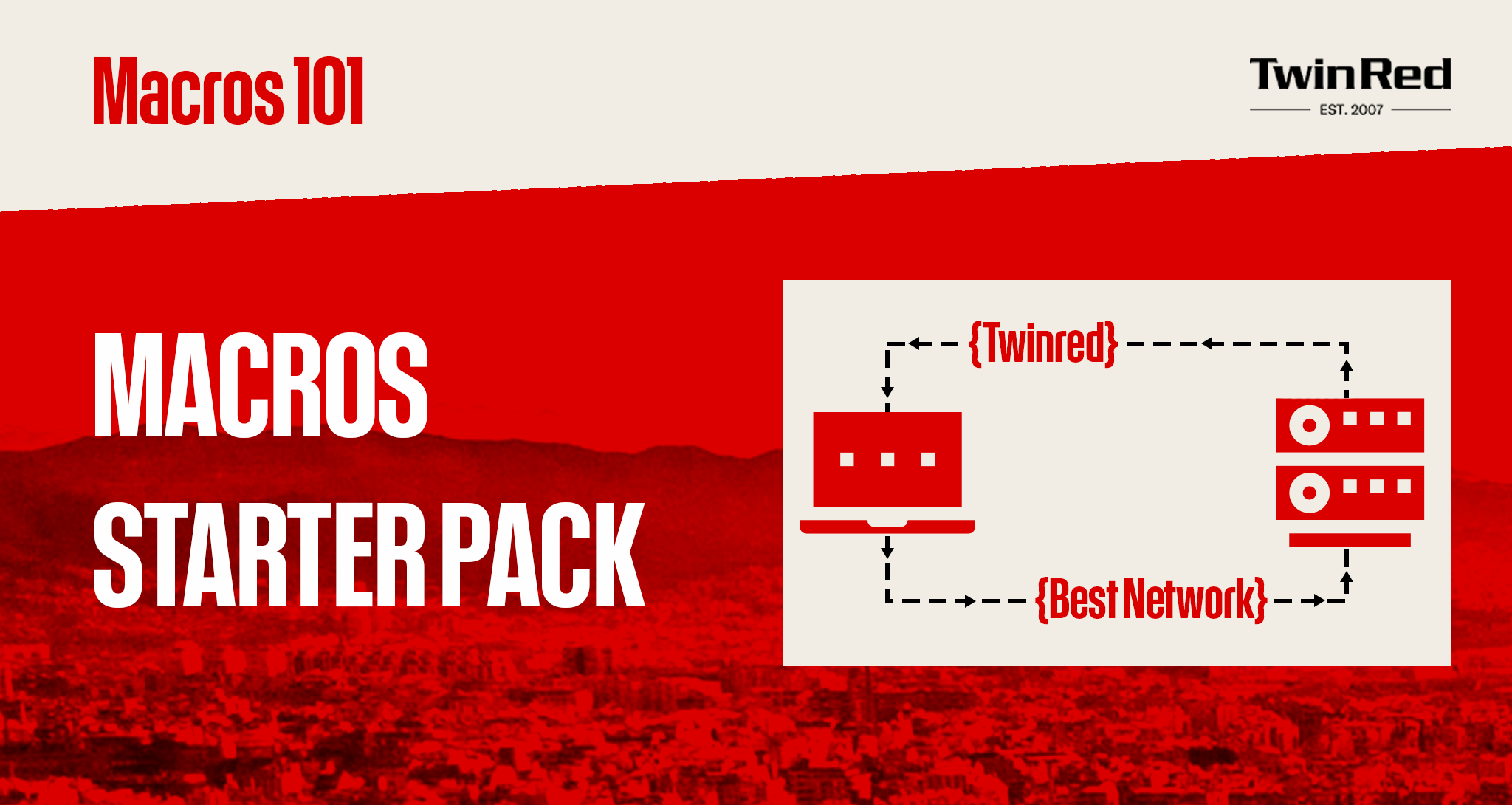 |
| Today we would like to tell you how to use macros. Another name for macros is tokens — unlike crypto tokens, macros are actually used in our day-to-day life. Macros are numerous, easy to implement, and very useful. There are many helpful bits of data that can be transmitted via macros and that are essential for thorough optimisation of campaigns. A wise affiliate wouldn’t move in the dark when it’s possible to make data-driven decisions. Without further ado, let’s start using macros! |
| What are macros? |
| Macros or tokens are simple commands for transmitting dynamic information within a URL so that you can fine-tune your ad campaigns. |
| For example, this is what you get if you apply the {browser} macro to your tracking link: |
xampleurl.com/?yourmacro={browser} |
| As a result, when a user clicks on your ad and is redirected to the stated URL, you will receive the information about their browser like this: |
xampleurl.com/?yourmacro=Safari |
| So you will be able to see more relevant data about your campaign in your tracker, which provides more opportunities for detailed optimisation. |
| How can macros be useful? |
| What are the uses of all these macros? For instance, there may be a browser that is incompatible with your landing page, so you would like to make corrections to your targeting. To find out, simply analyse the ratio of conversions to each browser to eliminate the rogue ones. |
| But that’s not all. We could, for instance, pass users’ location to you — that will be very helpful in determining the best-performing GEOs. Just use {city} macro and get the city name reported back to you: |
exampleurl.com/?yourmacro=Barcelona |
| Or use {domainId} to get the subdomains within a site. You can optimise the ad placements accordingly. |
| There are about 30 macros that will allow you to fine-tune your campaign. Find out where and from whom your conversions come from, see if you like it. When it comes to intel, knowing means growing (profit). |
| And don’t forget that TwinRed supports Server to Server tracking, which allows you to also track everything within the TwinRed system! |
| How to choose the right macros for your campaign? |
| The choice of macros depends on what you need, however, we recommend making {siteid} or {sitename} your bare minimum as understanding which websites are performing for you and which aren’t is crucial. |
| {siteid} macro is often confused with {zoneid}. Let us take a closer look at these two. {Siteid} corresponds only to an ID of a specific source. Example: Site A has a permanent id — 2929. {zoneid} represents a specific zone or area on a website: a footer, header, NTV A-C zones, etc. and is mainly used for banner/native zones. |
| {mediaid} is another macro we recommend for those who run more than one media in their campaigns (you should always run A/B tests). This way, you will be able to see what creatives work best for you and optimise accordingly. |
| We have also noticed that sometimes people get confused with cost macros. Let’s review them, as they are of great importance for advertisers (tracking your spend is essential). |
| {cpv} — a bid that you specify in our network when setting up a campaign, the amount you are willing to pay. |
| {bid} — represents an amount that you are actually paying: if you bid $2 and the second bidder bids $1.5 — you are only gonna pay $1.65. |
| {totalcpv} — reflects the total spend of your ad campaign. |
| Also bear in mind that you can request the list of all available tokens from your managers. And, of course, if you need any help with identifying the right macros for your campaign — our managers will be happy to assist you. Just let us know more about your goals, and we will do the rest. Your TwinRed team |
Trends in affiliate marketing and digital advertising 2022 The year is 2022 and the advertising business is growing ever-stronger and more products and businesses are discovering all the opportunities the Internet has to offer. But what is in store for those mastering the unique craft of traffic monetization? Let’s try and strike the next gold mine of traffic. The Internet Evolves, so should You  With new internet startups coming and going, some things stay the same. The people who come there. They come for the exact same reasons as 5, 10 and 15 years ago, even the content they come to consume stays the same. However, what is different is the ads market, which couldn’t be further from the Wild West it once was. With Google’s almighty grasp on the 70% of users with Chrome, publishers now have to submit to the will of the once “don’t be evil” corporation, which with its strikes only forges the already proven advertising formats into something better: Pop-ups turned into interstitials (does anyone really miss the bombardments of pops?) The banners can’t be really fiddled with, and the native ads seem to be prospering as we hear more and more advertising networks launching IPOs while providing the ever-growing volume of traffic. And all the ads got leaner, and for that only better (loading speed was always an issue). As the technical side of the internet and online advertising evolve, so should your marketing efforts. Pay close attention to your competitors with spy-tools, improve the quality of your creatives and copy, and keep coming up with new angles and approaches. A Good Product is Always in Season  Products and offers are a near and dear thing for every affiliate, and all of them essentially stay the same. They just get new packaging and distribution. We can say that it is so trendy to run Nutra in spring and dating during the cold lonely winter nights (both proven to give a boost in CR), but in the end, it all comes to the affiliate’s own unique approach and skill set. However, there is a rule that works every time: new is always better. It applies to everything, so never shy away from testing out new offers and verticals, new formats and creatives, as new offers tend to show better CR and actually help you learn new approaches and master new marketing funnels. Once you are sure that you’ve mastered a certain ad format, try running a new offer, or vice versa. The advertising landscape and consumer needs change way quicker than seasons, and you should be on the lookout for the best possible combination of traffic and offer, it may not be as obvious as you’d like, so you’d may have to test native for gambling and push for cams and then dating with pops and so on. Thankfully, you always have the help of your managers, who are in the thick of it and ready to share some insight. Ad Format of Choice  If you are still uncertain about what to run, then you’d better expand your horizons or try your luck in other industries, as you should understand one thing: everyone is ready to pay for your traffic. iGaming is booming all over the world. Crypto projects are launched every hour, magic pills and exciting games are being developed, and every single one of those enterprises is reliant on customers that you have the unique ability to provide. And the best part — about 90% of the aforementioned products are restricted one way or another in the walled gardens of FB, Google and TT. Those who run affiliate offers in the walled gardens require entire teams of people and vast infrastructure in order just to launch the campaign, just ask anyone running FB about their last adventure with setting up and launching a campaign. The good thing is that those platforms did a lot of testing for us, and the golden standard of modern ads was born, and it is a Pre-roll. A simple, short, catchy, informative pre-roll. No matter the vertical, this format shows the best results and brings advertisers the highest ROI. Give it 101%  It’s never enough just to set up, launch and stop a campaign to truly succeed in affiliate marketing. With growing competition in the field, savvy affiliates rely on every tool available, after all, they are created to make the most of every click and impression delivered. For every advertising format, there are tools and methods that can make it even more effective. For some, it may be audience segmentation after a “wide” test (you can learn more about your audience just by sorting through the categories of users’ interests provided by publishers and that can give your campaign just the edge to reach profitability). For some verticals and approaches, retargeting may work wonders (people’s interest can be reignited and with the right creative you can still catch the lead and make the conversion), and never-ever should you forget to collect all the data possible, so you can build your own push database (it’s just a single string of code for your prelander) and collect emails, so you can have a traffic source of your own. And the hottest trend in affiliate marketing is cooperation — reach out to your account managers and colleagues, to forum admins and designers that have just finished the 1000th creative you’ve ordered, ask for feedback, and you just may see the new way you can improve each and every aspect of your campaigns. No matter the trend, we are always here for you. Yours truly, TwinRed. |
Home > >