The Future of Native Media Buying (9)
What goes on in the background when you're buying media may interest some of you -- here's an insight into what I've learned and observed over the past few years being entrenched in the AdTech/programmatic world. Native is particularly interesting as more and more advertisers and performance marketers move their budgets to native. We see this trend as the number of events tracked on
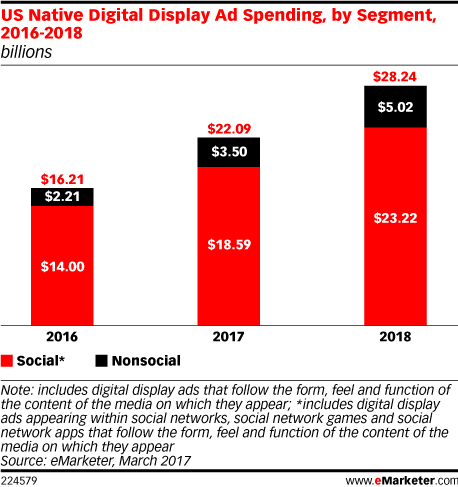
Source: eMarketer
The Future of Native Media Buying
Background
I thought I would share what I’ve learned over the last 2.5 years since I made the decision to build Voluum DSP. To give you some background on the ‘market research’ that led to the decision to build a DSP: a few years ago I had one of our devs pull a report to see how much ad spend we were tracking in Voluum TRK and to my astonishment it was close to $1 billion. The decision in my mind was made instantaneously - we’re going to consolidate tracking optimization and media buying. Little did I know, this would become the most challenging undertaking of my life. One which burnt out my CTO early on, and one which made me want to give up so many times I cannot even count. The programmatic part of online advertising may be one of the most challenging, complex, least transparent and understood industries in existence. An industry riddled with so much fraud that estimates range from 10% to 50% (of all traffic sold being fraudulent), nobody knows with absolute certainty because it is simply impossible to measure. Based on my experience I feel it’s in the higher end of that range. This industry almost seems like an invitation for organized crime, insane returns, no legal repercussions -- ad fraud is expected to become the second largest criminal activity second only to the drug trade. Technically, it’s not very difficult to generate fraud, implementing it is even easier. Fraudsters have an incredibly high incentive, face little to no risk, and as such they’re always a step ahead of those who futilely try to fight it - we know, we’ve tried.
On top of the fraud is the whole incestious nature of the programmatic advertising space. Both on Zeropark and on Voluum DSP we often observe the same visitor coming in 10+ times from multiple partners who re-broker, re-hash, re-bundle traffic often not even knowingly (truthfully, nobody in AdTech knows what’s really going on) sometimes foul players put in effort to try to make it look like their own traffic turning a profit on garbitrage. We invest a lot of time and resources to try to only buy from the original source of the visitor, but more often than not, it’s impossible and purely speculative.
This all leads me to native. I wanted to focus on native in this write-up but wanted to give you a broader background to put things in context. For your information, Voluum DSP initially was launched as a mobile display only DSP. When we started out, I had no idea to what extent display was riddled with fraud. I would speculate that over 50% of banner impressions sold are fake, it’s just very easy to do there and very difficult to get rid of and filter out. Banners are pretty much dead for performance (other than retargeting), banners are where brands waste millions of dollars on ‘branding campaigns’ often with no other metrics than we want ‘1 billion impressions’ or ‘1 million clicks’. Their blind behaviour and lack of performance KPIs is exactly what fuels the fraud in the first place creating a vicious loop where the fraudsters win, the exchanges win -- often knowingly selling fake traffic to jack up their revenues (something I confirmed speaking with insiders at a certain exchange). For publicly listed companies revenues are everything, these companies know that the fraud and bots exist on their networks, but why would you get rid of something that brings in revenues from brands that blindly buy it? How would you explain the massive drop in revenue to shareholders if you were to clean up? What about the company's reputation?
So what about the performance marketers that don’t have sophisticated tools to assess what media is worth buying and what media is worthless at best, if not utter fraud. Or tens of thousands of dollars to spend in a desperate attempt to find placements that perform? That is where I feel that technologically savvy DSPs will start coming into play. The SSPs and exchanges that work with direct publishers are typically organizations that came in at the ‘right time’ have outdated technology by now, and are backed by $100’s of millions of dollars in VC capital. All that creates is an incentive to not clean up, and continue to try growing revenues at whatever cost - even if that means knowingly selling worthless traffic, or worse, fraud. They have a mix of brands and performance advertisers so it’s in their interest. If their inventory was to be sold only to performance marketers they’d probably have to clean up and remove most of it.
Native
We've gained a good insight into all of this over the past year being one of the earlier DSPs to integrate with most of the native networks/exchanges/SSPs. There are so many variables to take into consideration - it is rather overwhelming. I'll list out some of the key points that we've learned and observed:
- We have around 160,000 sites/apps registered on Voluum DSP coming in from 20+ exchanges, of which only a small % ever generated any conversions in the past few months.
- A lot of networks re-broker and re-bundle the traffic of other networks, some even spoof (something I hope the ads.txt initiative will help with). (G)arbitrage is a big source of traffic which is why native volumes are so inflated.
- With header bidding, you get the same site coming in thru multiple SSPs. Some publishers have multiple widgets from various SSPs. It’s absolute programmatic chaos.
- Without the worthless sites and placements, revenues would drop so it is not in the interest of the native exchanges/networks to weed them out. They have a mix of brand and performance advertisers so most of it gets sold. Remnant traffic is often sold onto a ‘fallback’ which is another SSP/exchange which then sells it to its advertisers. Creating a cascading loop of trash, an environment for monetizing non performing placements, fraud, and bots - an incentive for not cleaning up and even growing volumes of poor traffic.
- The way things are now will not last for long, the whole industry is making strides towards performance where long term success is at.
This is where DSPs have a chance to shine by doing a lot of the dirty work. Their job is to make sense of the chaotic and incestious nature of the programmatic space. To weed out that which is worthless, and to understand where the valuable traffic is. To create a playing field where everyone has a chance to taste the traffic that performs and in that way, increase CPMs over time. The publisher's start making more as they are incentivized to improve their widgets and their placement, the advertisers stop wasting money. A DSPs #1 priority should be to deliver value and to make it easy, to automate, minimize waste, and to save time - in the end delivering profitable results to the advertiser.
I feel native in its current form is deeply inefficient because the incentives lay in the wrong place. It’s legacy from the good old days when you just slapped on a widget and left it there. Too many incentives for fraud, and not enough incentive for publishers to optimize widgets, their placements, making them really native and not just a bunch of banner like placements at the bottom of a page. This will be changing soon, maybe as soon as next year, as the whole native ecosystem moves towards programmatic (it’s happening now), where supply and demand will find the real price worth paying for sites and placements that perform, and worthless ones will be weeded out, left for the fish and the DSPs and agencies that operate inefficiently. The hike in CPMs will then encourage publishers to take a proactive stance in optimizing their placements, and SSPs will start to put in work into building better widgets, new formats of native ads because the native that we see now is in most part completely outdated and isn’t really even native to be honest.
Native was and continues to be a gold rush, with $100's of millions of dollars going into prepaying publishers by the likes of RevContent, Taboola & Outbrain. I feel the industry will start moving towards quality of impressions, not quantity - and with time programmatic buying and selling will make more and more sense.
I'm happy to answer any questions about native, and the AdTech ecosystem in general.
Awesome post, thank you Rob for sharing your knowledge. I'm currently on Native, I will be in Krakow a few days next year around June, hit me up if you want to meet up!
Bests
Fascinating stuff - thanks!
Interesting that you mention the fraudsters getting incredibly sophisticated. Can you go into a bit of detail about what sort of techniques and technologies they're putting into place these days to evade detection?
 Originally Posted by caurmen

If you want to get nitty gritty check out their research publications starting with this one: Compendium of Ad Fraud Knowledge for Media Investors
And this is a great publication from White Ops: The Bot Baseline: Fraud in Digital Advertising
Lately there have been quite a lot of case studies and reports about fraudulent traffic detection, including huge amounts of wasted budgets, techniques used to generate/detect fraud traffic and so on. Although the overall impact of these reports is positive, there is still a lot of work to do.
When we think of publishers that base their revenue on fake impressions and clicks is just enough, but when traffic sources get involved on such activities, it's definitely disturbing!
I don't think any performance marketer running Native or any other traffic type would think twice before doubling or tripling their adspent on low bot-free traffic sources.
Thanks, Rob! Looks like I have my in-transit reading for this holiday period sorted 
(Expect to see the fruits of this in the New Year, folks. I already see one tool from Botlab that could be very useful for STMers.)
Hey rob welcome to the US! Hope you are enjoying your new digs in California. So we have seen this big jump into native with no end in sight. What's next beyond more native? Where do you see the innovation coming from?
Can you provide an example of what a real native ad should look like vs a banner calling itself native?
Originally Posted by mviola
Beyond native is video, we've built out our Video DSP MVP and will continue investing heavily into that. Video is the future, programmatic buying of TV ads is not as far away as one may think. Imagine the day when you start retargeting web activity on a persons TV. It'll be revolutionary for advertising.
Right now, smart methods for retargeting, and creating look-a-like audiences is the hot topic. For example, within
In regards to a real native ad unit - it needs to look like a piece of the content - it needs to be contextually targeted, not some banner at the bottom - contextual real native will command insane CPMs $50+. Yieldmo does a good job at this: https://www.yieldmo.com/products/formats/
I am testing it now!
Home > Paid Traffic Sources > Native