building a job vs building a biz vs building saleable assets (24)
Hi STMers,
I'm new hear and I'm new to AM in general and i'm doing my due diligence on the possible business models before I dive in and start pumping in cash and i would really appreciate some advice.
I have built businesses before, a few have failed, one is still going strong. But, unfortunately, i have backed myself into a bit of a corner with a business that i can't sell as it's based on me and my contacts. It would be possible to systematize it a la Gerber's "the e-myth", but i'm ready to move on and try something new.
Reading all the great posts on this forum it seems that the AM world is shifting toward building businesses, or at least pretending to.
http://finchsells.com/2014/10/10/mel...s-meetup-2014/
http://iamattila.com/cool-shiznitz/s...uying-team.php
no-offence iamattila but i can't help but think of you as the ben affleck character from boiler room. https://www.youtube.com/watch?v=S63kIH96Bi0
You guys can build successful high performance marketing agencies.
so my question is, how do you build saleable assets with AM?
build a tracker ? build a marketplace?
Thanks!
hlghst
Honest marketing company or consultant is a good business in Asia, cos alot of cheaters and talkers in Asian countries no offens but i have lived in a few and got burned by a few also on my own projects. I know several forigners are succefull in Asia with IT and Marketing in general and there clients are forign corperations and big local companies. At least one has background in AM in early 2000. To be honest and offer them good help to market there product online . But people need to have some track record to show them that you can make it as AM first i think personaly. Alot of people offers IT and Marketing service but they dont know how to take there own small busienss from 0 to 100 or what is different betwin spend on branding or to hunt for sales and profit. So how shuld those be able to help clients? That is why people like attila brand themself as leaders in the field and have helped the community , they can show track record and references and that is big value when it comes to make a choice as a client who to trust your marketing budget too.
haha, yep, i've been leveraging the respectable white face in asia for 5 years now with my current offline biz. definitely not a bad strategy.
 Originally Posted by hlyghst

You know, this is a great question, and one that is not asked enough. You can certainly use AM strategies to build a business that is a saleable asset, and while a lot goes into that, there are two very important things to keep in mind:
1) What is the asset you are building?
2) WHO would be interested in buying that asset?
Two, quick stories to illustrate this. About seven or eight years ago, several web entrepreneurs teamed up to build an email newsletter for women called Daily Candy. It featured regional places to go or shop, cool things to do, etc. specifically geared towards women. The business owners built it with the express intent in mind of selling out to ComCast, and they did so after they’d built an email list of 2 million names over 2 to 3 years (I forget the specifics). Comcast at the time wanted a new channel to communicate with women, and so they did indeed buy out Daily Candy…for $160 million. Yep, your math is right, that’s $80 per email, an asinine amount, but to a big dumb company, they were willing to pay it. Like most big dumb companies, they screwed it up, and as of a few months ago, Daily Candy is defunct. But the original owners were happy because they built an asset with a specific buyer in mind and walked away with a pile of dough. There are plenty of sharpshooters on this forum who have the traffic skills to build a list that size in a short amount of time, these guys just did it with the intent of selling the audience.
A few years ago, Wall Street snickered at the CEO of Disney, after he “overpaid” for Marvel Comics. But Disney is much smarter than Wall Street because they knew that Marvel filled a huge need for them—they had nothing that appealed to teenage boys, and Marvel has a huge audience of just that (their asset). So, Disney bought Marvel because it had an AUDIENCE, and they knew what to do with more characters. The upshot was, Disney made their money back in 8 months, and Marvel has been a huge money maker for them. So, the asset was the audience and the characters, and the “Who” was Disney.
Probably one of the best books ever written about how to do this on a smaller level is:
How You Too Can Make at Least $1 Million (But Probably Much More in the Mail-Order Business) Paperback – December 1, 1992
by Gerardo Joffe (Author)
http://www.amazon.com/Least-Million-...=gerardo+joffe
Joffe had the distinction of building not one, but TWO mail order catalog businesses, and then selling them BOTH to Time, Inc (who then proceeded to screw them up). On one hand it’s “dated” because it is pre-internet, but on the other hand it is timeless…building an asset for a specific buyer.
AM strategies can certainly allow you to build the only true asset in a business which is a customer/leads list (both email and physical address) because most companies are interested in buying an audience or customers.
Hi John,
Thank you very much for your reply. That's interesting about a mailing list being the primary asset. I was thinking of an asset being a brand, proprietary tech, systems and processes, and of course customers. But you're right, when you distill it down to the essence the customers are what's necessary (particularly to IM).
In that vein, I've read your other posts about email marketing and they have been enlightening. Thanks!
So, you got a buyer in mind for your lists? 
-tom
Aha, that explains what the loud crash I just heard was - it was John dropping another gold brick of info on the forum!
I've bought that book now - thanks for the recommendation!
It's a great book-- what's hilarious is that Joffe not only sold his first catalog business (Hanover's, I believe?) to Time Life, but when they screwed it up, he bought it back from them for pennies on the dollar, renamed it Hennikers (I think), built it back up to what it was, then sold it to them a SECOND time. Truly an entrepreneurial inspiration...
Originally Posted by caurmen
Reminds me of the Brazilian billionaire that sold a bank to UBS, UBS screwed it up, and then he bought it back for half the money he received. Nice way to make some cash!
Can someone point out some posts in stm about building audiences? Short summary: we are in the process of building a niche website that is targeted at a specific audience. The brand's positioning is very clear to us, but we are curious to know about others's experiences in building audiences, and any tips or recommendations on the subject will be highly appreciated.
We don't know if we just want to sell the product to cash out or have a money recurring monetization strategy, though cashing out at the right price is always to be evaluated...
Originally Posted by afilia320
That would be a great index!
i believe johna5150 has written extensively about that. At least in terms of building emails lists. But i don't know the exact links.
http://stmforum.com/forum/showthread...product-advice
http://stmforum.com/forum/showthread...ome-Profitable
and
http://stmforum.com/forum/showthread...-You-Invest-In
have a lot of John's sage advice in them. Worth reading through!
John your posts are worth the STM subscription fee alone. maybe i should be sending you the 100usd a month
Have you ever tried the female dating market?
Originally Posted by hlyghst
If you have learned how to do AM effectively, then you possess some of the core essential skills that are required to either i) create deep pools of liquidity on both the demand and the supply in two sided markets or to ii) exploit any latent inefficiencies in asymptotic markets.
This graphic and post should at least give you some ideas on how to exploit these skills to create significant enterprise value:
The Magic of Liquidity
http://supplydemanded.com/post/36811...onmarketplaces
"I spent the summer of 2007 working at an online education startup in SOMA called Batiq. It was the summer after my sophomore year in college and my first introduction to the world of startups and to a group of individuals - whether they realized it or not - that would dramatically alter the way I thought about business and technology.
One of those people was a recent Harvard grad and our lead developer, Nathan Blecharczyk. We kept in touch over the next couple of years while I finished school and he moved on to his next project, ‘Air Bed and Breakfast.’
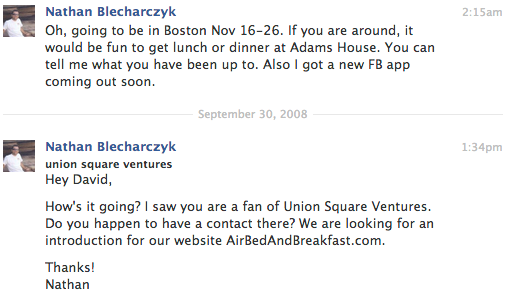
While I didn’t have a contact at USV at the time, I remember thinking that his business sounded neat, but that there couldn’t possibly be that many people who would want to share their home with strangers. Turns out I was in good company.
It wasn’t until the following summer while I was working for the founder of a pharmaceutical royalty company, Royalty Pharma, and watching Airbnb make waves during the Democratic National Convention, that I would fully grasp the potential of marketplaces. It made me internalize what “Liquidity” was all about.
What became clear to me during this time is the immense opportunity to be the liquidity provider in a market (existing or new) where there are valuable assets (be they real estate or pharmaceutical royalties) that are, under the status quo, under-monetized.
With its infinite space, instant access and seamless connectivity, the Internet provides the perfect medium to aggregate the long tail of fragmented and illiquid markets. This dynamic has made the opportunity for creating online marketplaces so compelling.
My colleague Andrew Parker perfectly articulated this point in his blog post from 2010, where he illustrated the ‘Spawn of Craiglist’ and the impact that it had in the various markets it addressed. As Chris Dixon recently highlighted, some of these opportunities are so large that they require specific focus to be successful.
I thought it might be worth revisiting Andrew’s graphic, to see how the world has changed since 2010:

I think it’s safe to say that there has been an explosion in marketplace businesses. These 82 companies (nowhere near exhaustive) have collectively raised close to $2 billion in venture capital and created many billions of dollars in value. As I look at this list as well as all marketplace companies that we get pitched at Spark, I keep coming back to a few salient points which I believe dictate the potential value of these companies:
- Size of the Market - Don’t be fooled by the incumbent market, think about the one that may be created or unlocked. While the initial focus might be small, what does the potentially broader market look like for this company (i.e. from couchsurfing to travel lodging industry in its entirety)?
- Excess Capacity– Some call it an asymptotic market, but it’s simply the fact that a good portion of a given industry is sitting idle or under-monetized. Why is that? Can it be changed by a new business?
- Friction / Opacity– Are there middlemen in this market that shouldn’t exist? The larger or more considered the transaction, the more likely there are intermediaries (i.e. buying a bike vs. buying a company). Intermediaries benefit from (and often perpetuate) opaque markets. They withhold information in order to make margin. Value is created when these intermediaries can be dis-intermediated.
- Fragmentation – Is this market highly fragmented, or are there a few dominant players? There isn’t much opportunity in a market where there is concentration on one side or the other.
- Customer Experience – Whether you become the transaction processor that eliminates an awkward in-person cash transaction or simply provide a more compelling user interface to a staid business (i.e. like Uber has done with the livery business), a better customer experience can be the differentiating factor for your success (and one that keeps transactions within your platform).
While these points are all inter-related (and there are certainly others that I have missed), these are the one’s I often come back to. If you look back on the graphic above, I believe that the most successful companies to date have addressed these issues.
While the talk of the Internet town these days is that the wind behind consumer Internet companies has waned, I still fundamentally believe that there are opportunities for businesses to provide liquidity to large previously untapped markets. I’m especially keen to see mobile-first approaches to marketplace businesses. And I also expect many of these marketplace dynamics we’ve seen in consumer businesses to emerge as key elements in the next generation of successful b2b and enterprise software businesses."
From http://supplydemanded.com/post/36811...onmarketplaces
^^ awesome post cmdeal!!
Originally Posted by cmdeal
thanks for the reply cmdeal. I hadn't really thought of affiliate market in terms of creating liquidity.
and b2b marketplaces, that gets the gears spinning. I can think of a few affiliate industry related marketplaces that would check off all of the author's "salient points".
I'm a little late to the party, but have some experience in selling various assets we've created.
Two of them were more about being in the right place at the right time in terms of certain market forces going on. One was the first dot com bubble and the other was more specific in terms of SEO.
The third and fourth times around, we had a good idea of who we would/could sell to before we even really got into the marketplace. We brought a competitive advantage in terms of lead gen skills, built the assets and then sold them for a decent multiple to the right people.
I don't really start projects/companies anymore without having a clear idea of possible buyers. I get nervous about building something with one specific purchaser in mind, because you never know what will happen. Obviously there is always someone ideal and you can build with them in mind, but it's better in terms of marketplaces to create an auction around an asset then just have a single buyer.
I know a few investment bankers in the space and they are worth their fee in gold. If you get an offer on an asset, sometimes it's worth talking to them so they can create an auction. There are all sorts of buyers in the marketplace that you would never know exist: Private Equity [I love Private Equity], Family Offices, Companies in parallel spaces trying to create a growth story, small funds, large funds, etc.
If you are in AM and know how to generate leads/sales/actions at a certain CPA then you are waaaaaaaaaaaaaaaay ahead of the game. Whether you're building B2B or B2C, the number one thing that will guarantee success is either your positive growth in B2C or your lead pipeline in B2B. Of course I am assuming that you have all your other ducks in a row and those things contribute to positive cash flow, profit, etc. I'm old school, less interested in valuations then I am in money.
If you are involved at the startup space at all then you will know that they're so bad at generating demand that they had to come up with a term called "growth hacking" to make them seem like they knew WTF They're talking about.
Great post.
And totally correct on creating an auction.
I had some discussions a few years ago with the guys at http://arboradvisors.com/ on a couple of web properties. They connected to the right people and created an auction situation.
Originally Posted by dynamicsoul
Yah, Arbor trolls Affiliate Summit lists and will have an associate meet you for a few minutes to prequalify you. I didn't get a good vibe from them.
I personally send everyone to Founders IB down in Alabama, as I am friends/associates with a lot of the entrepreneurs they've done deals for. If you want a warm intro drop a PM.
Originally Posted by ari_
Originally Posted by hlyghst
We left it on the table, then when I started to revisit it all about 8 months later, my Arbor guy had left. It felt like the process was starting all over again, so didn't pursue it further.
I still own the properties.
Good experience, gave me a good insight into what I would need to do, how to get my biz structured to make it easier to sell in future etc.
The thought of restarting most the process again put me off a second time, and my focus had sort of shifted a bit.
Home > General > Affiliate Marketing Forum