Amazon SLASHES PRICES for S3, EC2, ElastiCache, Elastic MapReduce And RDS (13)
Amazon SLASHES PRICES for S3, EC2, ElastiCache, Elastic MapReduce And RDS
Amazon SLASHES PRICES for S3, EC2, ElastiCache, Elastic MapReduce And RDS
Looks like a great price war!
From http://techcrunch.com/2014/03/26/in-...3-ec2-and-rds/
Amazon today announced a new round of price cuts for a number of services on its cloud platform, including its S3 storage service, EC2 cloud computing platform, ElastiCache, Elastic MapReduce and RDS cloud databases that will bring the cost of running applications on Amazon’s platform closer to the new prices Google announced earlier this week.
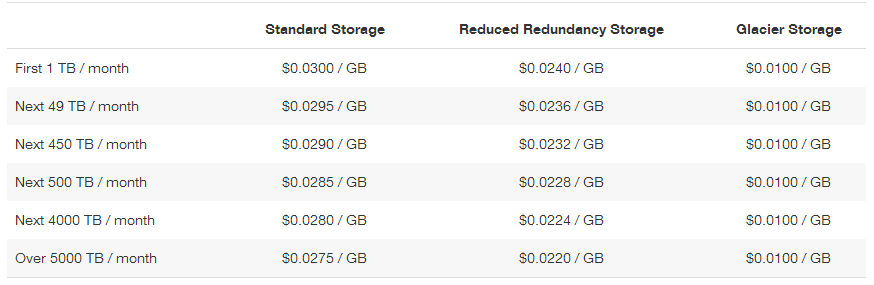
For the first terabyte of data, Amazon’s S3 will now charge $0.03 per gigabyte on standard storage and $0.024 for reduced redundancy storage. In addition, Amazon also cut prices for its EC2 cloud computing instances by up to 40 percent.
Users who store more than 49 terabyte of data will see price cuts, too, though for standard storage, prices never drop under the $0.026 that Google now charges after it abandoned its own storage tiers in favor of a single price.
For Amazon, these are massive price drops. Across the board, Amazon says, these cuts amount to savings between 36 percent to 65 percent.
For EC2, these price cuts amount to savings of up to 40 percent. Running a standard m3.medium instance, for example, currently costs $0.113 per hour, but with the price cuts, running this instance will cost only $0.07 per hour. That’s the same as using Google’s basic n1-standard-1 instances.
These price cuts don’t apply to all instances, though. Running some of the most expensive instances like the memory-optimized cr1.8xlarge instance, for example, will still cost $3.5 per hour, even as some of the smaller memory-optimized instances get substantial price cuts. Amazon’s smallest micro instances, too, will also remain at $0.020 per hour.
Prices for reserved instances, it’s worth noting, also dropped substantially.
Amazon’s RDS database service, too, is going to see 40 percent price cuts across most instances. ElastiCache cache nodes will get 34% cheaper and Elastic MapReduce will see price cuts between 27 percent and 61 percent (that’s in addition to the EC2 price cuts).
All of these new prices will go into effect April 1st (just like Google’s price cuts).
Clearly, Google’s price offensive is taking a hold in the cloud industry. Now that Amazon has made its own round of cuts, it’s just a matter of time before Microsoft will drop its own prices.
From a technical illiterate...are any of these services useful for AM? like could replace a VPS or dedi?
Ah great news, this move will save me around 10k$ per year all-in!
@ricmed I use AWS for the availability/reliability/speed. When you run a big campaign you can fire up servers when you need them (near the location you're running traffic) then cut them back and 'pause' them when you're not running traffic (this saves so much because they bill based on hours used).
A technically illiterate guy could get a server up and running with CPVlab in under a day (following a tutorial) but you'd ideally need a server guy on hand for all the unexpected problems that appear. In over a year I've never had to contact AWS to deal with a problem, that's why I love them! #1 hate in affiliate marketing was hosting before I moved everything here a few months ago.
It's a pity that AWS is such a nightmare to work with in terms of very simple operations. This is great though for firing up nodes on demand if you need something reasonably pricey, where hourly billing is advantageous.
In some cases it can be just as price effective to roll out a VPS with a random provider in that country, provided you can set things up quickly. The smallest current generation compute instance for example is ~$90/month in e.g. Tokyo but you can surely get a similar VPS there for half that, although maybe with a monthly term.
Snipe, do you have images set up so that you can roll out new nodes from a disk mirror or similar?
I have been working on some cool load balancing ideas that would work great with this setup but so far am limited by the tracking systems.
Be careful not to confuse amazon S3 (storage service) with Amazon Cloudfront (CDN). They are two different things. S3 is designed for storing (and transferring) huge amounts of data cheaply. The CDN is the Content Distribution network that will move your content closer to your target Geo.
EC2 will fire up servers in whatever Geo location you specify (assuming its available).
I am posting this because I actually made that mistake some years ago when I was getting started. I thought that by storing my stuff on S3 it was gonna work like on a CDN.
True, but once you get over the learning curve it's worth it. Everything becomes easier once you manage to get your head around the 20-30 different services they offer! Yes! That's my favorite thing about AWS, I have a few different setups and save them all as images (fresh installs of WP/CPVLAB/scripts etc).. then roll them out when needed. Simple as a few clicks. With AWS Beanstalk you can automate all the server spawning from one of these pre-created images if CPU levels go over a certain amount.
I don't do huge volume in terms of clicks, but if you're going down the load balancing route to really scale (tens of millions+ of clicks per day) go with DynamoDB for sure (HasOffers use it). It can handle billions of rows with ease. If you're familiar with MySQL, DynamoDB will be easy for you. Then spin up some EC2s to do the report processing for you to an RDS MySQL instance. For EC2 always try and get report processing done with spot instances to save you a ton!
In the end, getting a setup like above will cost you quite a bit of time (and it's not exactly cheapest option), but for peace of mind in the end - I'm happy with the startup pain! It might be wiser to pay a server guy to do what I mentioned and focus your efforts on new campaigns. It took me a few months of tinkering to feel 100% comfortable with AWS. I always want to know as much as possible about the setup, so when I get a server guy I can put him through his paces and make sure he knows his stuff.
With costs you're 100% right (even at the sliced price currently) local providers will always cheaper. Heck, I could do 1million clicks per day on a $20 box if I put my mind to it in most countries, but dealing with local providers always turns out to be a royal pain in the ass for me. For guys around here on a tight budget - finding cheap local hosts would probably be the smarter way to go (to make every penny go as far as possible). If you're more experienced and not happy with your current host OR are looking to scale to the sky, AWS is the way to go. There are other options out there, but for me, in 2014, it's AWS.
Does AWS offer a geo-distributed database service? I.e. MySQL or similar instances that are kept synchronised between datacentres? That would be useful, but possibly technically difficult.
@Zeno yes they offer RDS, and they also slashed those prices. Cheaper then hiring a DBA!
Yeah I know of RDS but I'm pretty sure it's just a typical cloud database, i.e. a single box in a single data centre that you can offload database workload to. To sync databases between datacentres you'd likely still need to make one in each and set up replication. Just wondering if there is any service out there that does this automatically - i.e. your database read/writes go to some local node and they are all synced periodically.
I think they offer slave master, I know you can run the same DB in multi az within the same region.. RDS is not exactly like a regular mySQL instance as you give up some of the fine control you might have because of no access to the mysql config file. But we tested a 40GB db that is ever growing against clearDB via Heroku and it was a no brainer.
@snipe - which instance types are you using mostly? I've done some testing on the standard AWS instances, and their I/O performance was terrible - but I hear the high-I/O servers are a completely different beast.
@zeno I'm not sure, it would be handy to have a 'master' database that could easily route to GEOs around the world, but it sounds like a lot of trouble/costly to set up. I find it easier to just launch setups in the region I'm targeting the campaign. Multi-AZ won't really help with the geo side if you're going broad around the world, Multi-AZ is more for keeping the data online if one database/server/region fails.
@caurmen Yeah the standard instances are less reliable. I've heard people say they've noticed differences of x10 I/O performance on the same instance type (on different launches), luck of the draw in some cases! When you go larger that's not really an issue. You should try out a SSD with provisioned IOPS (maybe the c3.large) and see how results compare.
*Adds testing AWS to the STM Case Study To-Do List*
Cool, will do! Interesting to hear the random difference in small instance AWS I/O times - that explains the occasional holy wars that break out on Hacker News and elsewhere when the subject of AWS performance is raised...
Home > General > Affiliate Marketing Forum